Showing posts with label predator. Show all posts

Friday, 3 April 2015

Fiddler Crab Predators

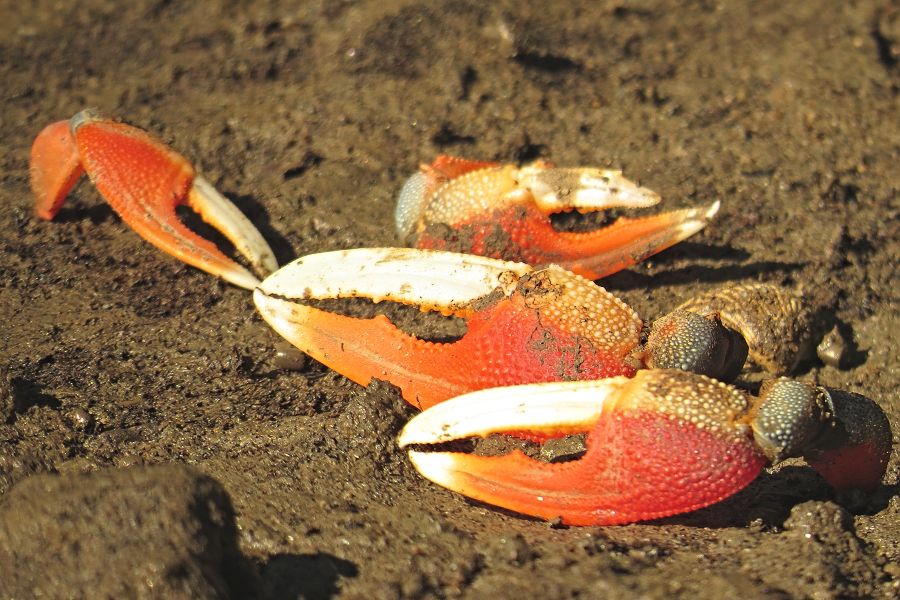
A lot of people have been looking at the “who eats fiddler crabs” post and I was starting to wonder if they had gone on the Paleo Diet.  When I wrote the first post, I was not sure which of our large birds had been dining on fiddler crabs but now I have collected more evidence.  Today on a small mud bank 10 m across, I found 4 detached nippers and bird footprints.  I would say a Beach Curlew (Esacus magnirostris) has been at work.
Uca dussumieri claws
The fiddler crab claws broken off by the bird - collected by me
There are more than a dozen large to very large birds in my area and some smaller ones with strong beaks, so working out who eats crabs is quite hard.  They very rarely eat crabs whilst you are watching and Beach Curlews are notoriously shy.  However I did see one giving something a really hard time one day and went to investigate.  I found the remains of a large sentinel crab.
Sentinel crabs probably put up a struggle and would be a bit bony to swallow, so the bird processes the crabs first and removes most of the hard bits.  It is more common to find the scene of the carnage than see it happening.

Esacus magnirostris, Beach Curlew eating a crab
Beach Curlew working on the shell of a sentinel crab
Sentinel crab remains
The actual crab shell from the Curlew's mouth
Scene of brutality against a crab, see the legs and shell.

Finally, I came across some Beach Curlew poo on a disused road that runs through the mangroves.  The curlews sleep there.  It is clear that crabs are a major dietary item.  When they eat soldier crabs it looks like the road runner in real life as they run the crabs down.  I don’t know how they catch sentinel and fiddler crabs as these crabs are fast and are always near a burrow.  Stealth is the more likely approach and I have seen Beach Curlews on the mud bank but they just stand there like they are waiting for the tide to go out.  They didn’t seem to be in attack mode.

Beach Curlew poo, mostly crab shell
On another web page someone said Whimbrels eat fiddler crabs.  Whilst this is possible and a Whimbrel was feeding near the mud bank, I would want to see more evidence before adding Whimbrels to the list.
Mouth of Richters Creek, Cairns - sort of place where birds catch fiddler and sentinel crabs
Uca dussumieri fiddler crab - the biggest of east Australia's fiddlers
Sentinel crabs in numbers on the sloppy mud.

Sunday, 28 December 2014

Fig parrots depart the nest

One young double-eyed fig parrot nearly did not make it.  The black butcherbird had him and was flying off but the butcherbird fumbled the chick and I was able to recover it.   It helped that the butcherbird was looking in the garden for chick, otherwise I would not have known where the chick was.  I do not know how the butcherbird caught the chick and I suspect that the chick was on its first venture out of the nest.
Cracticus quoyi
Black butcherbird thinking about how to catch caged birds
A day before, I photographed the chicks in the nest hollow.  When you move near the tree, they hide, but if you stand still for a few seconds, they can’t resist having a look.  It must be very hot in the still air of the hollow and in the late afternoon they are almost gasping for cool outside air.

Hiding fig parrot chicks
They can't resist taking a look for long
I imagine that a number of predators that stalk my yard could have eaten the chicks. Carpet snakes, lace monitors, tree snakes, kookaburras and of course black butcherbirds make up the main threats. Tree-climbing rats could also be an issue at night.  All these animals are present in the Cairns suburbs, particularly the older suburbs with quarter acre blocks that are not far from swamp or rainforest.  In fact, in mid-October I viewed a large chick in the nest and this chick may not have made it.  Birds grow fast and I do not think that a chick that was large in October would be the same bird as the chicks which I watched in December but then I do not know much about fig parrots.

The recovered and unhurt chick
I put the lucky chick back in the nest hollow.  He went in and was silent for half an hour.  The parents had seen the black butcherbird take the chick and then a human jump a fence and catch the chick so they were quite upset.  They refused to go near the nest hollow but instead flew some high reconnaissance circuits around the nest tree and made loud alarm calls.  The unaffected chick was calling for food loudly.  Suddenly I saw three parrots fly directly from the area of the nest to the dense canopy of a nearby weeping fig.  I suppose that both chicks simultaneously flew the nest.  The chick I rescued and that could not fly at ground level could drop from the tree to pick up speed then fly fast and level.  After six months of watching this nest hollow, suddenly it was empty.

Search this blog for fig parrot to see more.

Sunday, 22 June 2014

Crocs, People and Creek Mouths

Creek mouths are magnets for people on warm sunny day. The crab habitat gets trampled and I wonder how the crabs manage to survive.

On a sunny day, everyone is chasing fish at the creek mouth
If you are not interested in fishing, you can swim in the mud with your brothers and sisters
Sentinel crabs that share habitat with the mud-swimmers
In the search for more pristine habitat I went to another creek mouth about 50 km from Cairns to look for the  locally elusive Uca polita fiddler crab but had to rethink my plans.  There was a crocodile that was larger than my boat and faster too so I had to put some distance between it and myself.  Around the bend and about 100 m away were the weekend crab tramplers.  It is not uncommon for crocodiles to be within visual distance of people and the people to be totally unaware.  I sometimes took binoculars to a creek mouth, lay down on the sand so that I could see under the overhanging branches and looked for crocs and I would see them and nobody else was aware of their presence.  When boats approached, they would quietly slide into the water unseen and come back out when the boat moved on.  Crocs are not put off by noise and human activity.  One of the best places to see crocodiles was on the Barron River where the Cairns Airport landing lights span the river.  Screaming jets tensing up before landing would pass only tens of metres above the crocodiles.  They even nest in unlikely habitats like than.  

3.5 m croc and girl friend at creek mouth
Crocs run and jump off banks and can end up in your speed boat if you cruise at speed close to the bank - they have hit the side of my boat on a few occasions.  Years ago, when I had been padding around in the sea on a surf ski for hours, I paddled into the creek mouth shown above and up the edge of the channel to stay out of the wind.  A croc came running out of the mangroves and stopped with one foot hanging over the lip of the bank just in front of me.  On a 17 foot long surf ski, turning fast is not possible so I had to maintain my composure paddle within 2 m of a 2.5 m croc perched on the bank.  Sometimes you can even run into crocs in coastal waters.  With me it has usually been near misses caused by me surprising crocodiles.  Crocs generally avoid us but always stay on guard.  I recommend that you make an effort to see the crocodiles that share our waterways as it helps to know your potential enemy.


Wednesday, 18 June 2014

Who Eats Fiddler Crabs?

You would think that fiddler crab colonies would be a magnet for predators as the density of fiddler crabs is often really high.  However in all my years in the mangrove environment, I have rarely seen anything eating or attempting to eat fiddler crabs.  I suppose the lesson is that you often have to work hard to see predators in action.  It is also possible that fiddler crabs are not very good to eat.

Animals that are known/said to eat fiddler crabs include ibis, terns, possibly the giant mudskipper and the mangrove kingfisher.  At high tide, fish and rays will also eat any fiddler crab they can find. Mangrove kingfishers certainly eat crabs and recently I spotted one that appeared to be hunting fiddler crabs.  Being short of time, I could not sit and watch, however you can see several sets of fiddler crab eyes watching the kingfisher – look along the ridge line behind the kingfisher.  Mangrove kingfishers (Todiramphus chloris) are are much larger than other kingfishers and make a loud kak kak sound.

Todiramphus chloris
Mangrove kingfisher hunting crabs on the mudflats of Tingalpa Creek
Below is the would be prey of the kingfisher, Uca longidigitata, a fiddler crab which is common on the mudflats of Moreton Bay, near Brisbane.  They are mostly not very colourful, however some are a turquoise with sky blue nippers.

Uca longidigitata

Uca longidigitata

Of all the birds, the Great -billed Heron (Ardea sumartrana) would seem to be the ultimate fiddler crab catcher.  It is a massive and powerful bird which stands around 1.15 m tall and is only slightly smaller than a Jabiru.  They usually hunt the mangrove waterways near river mouths.

Ardea sumartrana
Great-billed heron hunting along waters edge
I watched the individual above as it slowly walked along a river bank and through 50 m of particularly rich fiddler crab habitat.  The bird showed no interest in the crabs and was only hunting something in the water, probably mullet but possibly other fish and prawns.  This does not prove that great-billed herons don't eat fiddler crabs, only that this individual was not interested at the time of observation.  It would require observations of many great-billed heron individuals for tens of hours and in many places and seasons before a properly substantiated statement could be made.  That said, all of my observations of great-billed herons suggest they hunt fish not fiddler crabs.

Fiddler crabs behind a great-billed heron.
The one animal I have seen attacking a fiddler crab was a small juvenile mud crab.  It had was wresting with a mature male two-toned fiddler crab of the same size that had wandered past the mouth of its burrow.  Unfortunately I could not stop and see what happened.

Update June 2017
Since this post was prepared, I have been actively looking for Fiddler Crab predators.  Here are some other posts on the topic.


Saturday, 24 May 2014

Fiddler Crab's Retreat

Fiddler crabs need to be afraid when the tide comes in.  In photo below a grapsid crab has not taken notice of the incoming tide and its legs are in the water.  It is in great danger as a banded toadfish (Sphaeroides pleurostictus) has seen it and is intent on making a meal of the crab.  Toadfish have teeth that easily cut through the shells of almost any crab.

toad fish hunting a crab - Sphaeroides pleurostictus
Toadfish hunting a crab
The best thing for a fiddler crab to do is hide in its hole. As an added measure, fiddler crabs also hide entrance to their holes. As the tide rises, the crabs know as their internal clocks tell them it is time to cut out a mud door and seal then entrance once they are inside their holes.

A fiddler crab making mud door
Uca dussumieri cutting a mud door
The video below shows a fiddler crab (Uca coarctata) making a door for its hole.