Showing posts with label behaviour. Show all posts

Saturday, 4 July 2015

Natural habitat of the Pet Hermit Crab

Many pet hermit crabs come from the Northern Territory in Australia.  Terrestrial hermit crabs have a planktonic larval stage in the sea, so they are not the sort of animal that is easy to breed in captivity.  As a consequence most pet hermit crabs are wild collected.  At least 30 000 crabs are sold to the aquarium trade every year according to official records.  These crabs are sold both within Australia and in North America and Europe.

In Australia, one species of terrestrial hermit crab (Coenobita variabilis) is found across the top end of the Northern Territory and some other species are found on coral cays in the Coral Sea/Great Barrier Reef. Hermit crabs occur in places where they have access to seawater, freshwater and terrestrial vegetation.  In practice this probably restricts them to low energy shorelines or rocky coasts where they can scramble over the rocks to reach pools of seawater without getting washed into the sea.  Most terrestrial crabs drown if they are underwater for a prolonged period and I suspect that these hermit crabs would do so too.  People who keep hermit crabs report a freshwater requirement but I am not sure how they find freshwater in their habit as these places have prolonged dry seasons and the ground is very porous.  The availability of sea shells probably limits where the hermit crabs can live.  Even though good habitat appears to be available in Far North Queensland, for example, this area has very few gastropod shells on the beach but is rich in useless bivalve shells.

The Northern Territory is a land of strange rocky coastlines that are perfect for hermit crabs.  Over aeons minerals leached from the tropical soils are deposited in layers in the ground that area exposed on the coast.  Bauxite, laterite, hard clays, beach rock and occasionally cemented sand create a wild array of coastal geologies.
Bauxite cliff
Bauxite cliff with kaolin and laterite lower layers - a place riddled with hiding places
Hermit crabs appear to mainly inhabit crevices in the rock formations near the water's edge during the day then go foraging in the grasslands and forest patches at night.  For a slow moving animal that makes an unmistakable track, they sure are hard to find at night.  The only time they were easy to observe was when they were climbing up the cliffs and sand dunes in the late afternoon.  As soon as they see you coming, even if you are more than 5 metres away, they often just let go and rolled down all the way to the bottom.
cemented sand boulders
During the day hermit crabs also hide under these cemented sand boulders
Terrestrial hermit crab on sand dune
Some hermit crabs climb straight up the slip face of the sand dune, which must be really hard
Terrestrial hermit crab tracks
Other hermit crabs seem to follow well-known paths
Hermit crabs tend to live in colonies where they seem to get along peacefully.  Living in colonies helps hermit crabs find new shells as when larger crabs find a new shell the old shell becomes available for smaller crabs and a cascade of shell updating may occur as progressively smaller crabs each upgrade their shells.  There are actually scientific papers written on this phenomenon, which is known as vacancy chaining.  Crabs actually hang around with slightly larger crabs hoping to grab their old shells when they upgrade.  When a number of crabs of different sizes group together in order to upgrade with the big guy does, this is a vacancy chain.

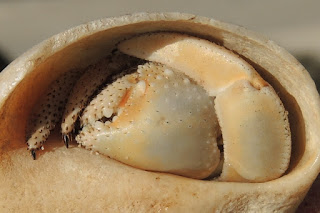
On capture, terrestrial hermit crabs can be quite feisty and will attack fingers, even though they have to come along way out to do so.  If they feel threatened, they pull back into their shells and block the entrance with their nippers and legs, something that marine hermit crabs can't do.  Marine hermit crabs are timid in comparison.
Australian hermit crab
Terrestrial hermit crabs are not shy
Terrestrial hermit crab nipper
Terrestrial hermit crabs can also seal the door with their legs.  
Terrestrial hermit crabs feed on a variety of things but probably eat mainly vegetation.  In captivity, they readily eat the vegetables that people eat.  In the wild, I was only able to observe them eating an old mangrove dropper (Rhizophora stylosa propagule)

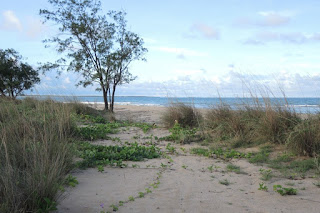
Coastal grassland hermit crab habitat
Typical seaside grassland habitat
Coenobita variabilis habitat
Laterite and beach rock shelves on beaches also provide foraging areas. 

Coenobita variabilis feeding
Hermit crabs feeding on mangrove propagule

Hermit Crabs as Pets

When it comes to invertebrates, I think that hermit crabs are one of the best choices there is.  They live up to 10 years, which is longer than almost all insects.  They are also quite active and move around on the surface, unlike many insects which bury themselves in soil as soon as they get a chance.  Insects can also be very robotic with a very limited set of behaviours.  In contrast, hermit crabs seem to explore their enclosures and active hide from us when we get close.  They pull back into their shells and roll down of what ever object they were climbing or try to run under something. They also try to burrow under their water bowl and will climb up anything and will swing from the roof of their enclosure if they get the chance.

Hermit crabs can't tell us how they feel so we have to look for indirect signs of whether they are happy to be pets.  So far, I have only had to release one invertebrate because it was so desperate to escape that it was not worth keeping and that animal was a red claw (Cherax quadricarinatus).  Most insects are clearly not worried about being contained provided they have food, water and mates.  If invertebrates are unhappy, they tend to lurch around their enclosures constantly.  I think that hermit crabs are on the verge of intelligence and require some additional care to make their enclosures interesting.  Hermit crabs also require warmth and fresh and saltwater.  They are very easy to feed, eating many human foods.  They also like the company of their kin and lots of empty shells to try out. Give them what they want and they will be happy.  People are crazy for hermit crabs and there are many pages with good advice on keeping them.


Friday, 3 April 2015

Fiddler Crab Predators

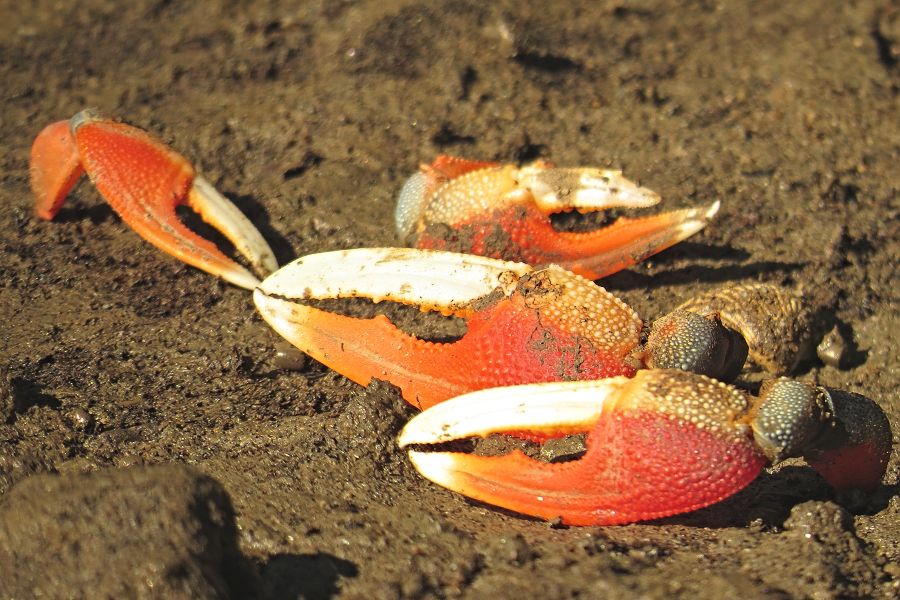
A lot of people have been looking at the “who eats fiddler crabs” post and I was starting to wonder if they had gone on the Paleo Diet.  When I wrote the first post, I was not sure which of our large birds had been dining on fiddler crabs but now I have collected more evidence.  Today on a small mud bank 10 m across, I found 4 detached nippers and bird footprints.  I would say a Beach Curlew (Esacus magnirostris) has been at work.
Uca dussumieri claws
The fiddler crab claws broken off by the bird - collected by me
There are more than a dozen large to very large birds in my area and some smaller ones with strong beaks, so working out who eats crabs is quite hard.  They very rarely eat crabs whilst you are watching and Beach Curlews are notoriously shy.  However I did see one giving something a really hard time one day and went to investigate.  I found the remains of a large sentinel crab.
Sentinel crabs probably put up a struggle and would be a bit bony to swallow, so the bird processes the crabs first and removes most of the hard bits.  It is more common to find the scene of the carnage than see it happening.

Esacus magnirostris, Beach Curlew eating a crab
Beach Curlew working on the shell of a sentinel crab
Sentinel crab remains
The actual crab shell from the Curlew's mouth
Scene of brutality against a crab, see the legs and shell.

Finally, I came across some Beach Curlew poo on a disused road that runs through the mangroves.  The curlews sleep there.  It is clear that crabs are a major dietary item.  When they eat soldier crabs it looks like the road runner in real life as they run the crabs down.  I don’t know how they catch sentinel and fiddler crabs as these crabs are fast and are always near a burrow.  Stealth is the more likely approach and I have seen Beach Curlews on the mud bank but they just stand there like they are waiting for the tide to go out.  They didn’t seem to be in attack mode.

Beach Curlew poo, mostly crab shell
On another web page someone said Whimbrels eat fiddler crabs.  Whilst this is possible and a Whimbrel was feeding near the mud bank, I would want to see more evidence before adding Whimbrels to the list.
Mouth of Richters Creek, Cairns - sort of place where birds catch fiddler and sentinel crabs
Uca dussumieri fiddler crab - the biggest of east Australia's fiddlers
Sentinel crabs in numbers on the sloppy mud.

Sunday, 22 June 2014

Catching some Winter Sun

Fiddler crabs wave their nippers for various reasons. Some crabs seem to get stuck halfway through a wave and hold their nipper out for minutes on end. When I saw that the little feeding hand was also held out, it became clear that the crabs were sun baking. The crabs are also oriented to catch the most sun. Being Cairns on a warm day, it was not cold by any stretch of the imagination and I can only guess how warm these crabs were getting. Down in the boundary layer next to the ground, where the wind is almost non-existent, the crabs may get quite hot. Years ago, on a mangrove planting project, many of the mangrove droppers/seeds (Rhizophora hypcotyls) got so hot at the point the dropper entered the ground, it killed the droppers. There would be a ring of dead material at ground level, with the below ground part and the above ground part being fine. Based on that experience I would think that a temperature of forty degrees or more would be possible. These sorts of temperatures are often dangerous for invertebrates and it would be interesting to know why the crabs are warming them selves up. A thermal imager would have been handy to see how hot the crabs were getting – they are now only $350 or the price of a good compact camera.  
Uca vomeris
Uca vomeris in the sunbaking pose
Uca vomeris
All dried out

Friday, 13 June 2014

Do Mangrove Ants know about Tides?

I often wonder why crustaceans dominate the mangroves and not insects.  In comparison to crustaceans insects seem so advanced.  Just to name a few advantages of being an insect:

  • Being able to fly;
  • Living in colonies with division of labour;
  • Having long antennae that allow an animal to feel its way along in the dark;
  • Different breeding strategies e.g. making nests, bearing live young; and
  • Lack of planktonic larval phase which probably facilitates rapid speciation (i.e. local populations can be reproductively isolated.

So why aren’t insects dominant?  The answer to that question would need a book but one chapter in the book would be the ability of animals to match their activity with the tides.

When I was young, I created a small mangrove swamp in a fish tank and kept fiddler crabs.  Even though the fiddler crabs were separated from the sea, they still knew about the tides times and would make their little doors which   they use to seal themselves in their burrows at high tide.   In the wild it is easy to observe fiddler crabs closing their burrows before the advancing tide.  Whether they just use their internal clock or whether they pick up environmental cues as well, I do not know but tides are complex so I suspect that the crabs use both.  East coast Queensland has two high tides a day but the Gulf of Carpentaria has only one high tide a day.  At the tip of Queensland, where the two seas meet it can be high tide in one and low tide in the other which results in the famous horizontal waterfall.  Thursday Island which is three kilometres long can have high tide at one end and low tide at the other.  It would interesting to see if fiddler crabs from one end of the island measure tides differently to those at the other  

If fiddler crabs are masters of telling the tide, what do ants know?  I found an ant trail of the mangrove swimming ant (Polyrhachis sokolova) and decided to watch how the ants reacted to the incoming tide.  The trail was about 20 m long and ended at a tree on the seaward fringe.

polyrhachis sokolova
A mangrove swimming ant - Polyrhachis sokolova 


Polyrhachis sokolova habitat
Ant ascending tree at end of trail
Despite the approaching tide the ants continued to march the trail.  Some early sets of ripples flooded the area around the tree and I thought that the ants would get the hint, but when the water drained away, they just resumed marching the trail.  However as the trail had been washed away they were wandering around trying to get some bearings.  Still there was no panic.

polyrhachis sokolova looking for trail
Moment of truth - 1 second until the tide arrives - and still no reaction
incoming tide pouring through mangrove roots
Too late!
The ants are good at floating on the surface film and are good at swimming, however they would be no match for incoming tide, especially on a day with a strong trade wind, which add wind-driven surface currents to the flow.  There must be more to the story as I doubt that the ants could survive loosing many of their number with each incoming tide.

polyrhachis sokolova floating on water
Ant floating in a pool left by receding ripples
More information: David Attenborough video clip on mangrove ants.


Tuesday, 20 May 2014

The Robust Fiddler Crab's Secret

Everybody has to do something special to survive.  The robust fiddler crab (Uca dussumieri) is the largest of the Australian fiddler crabs and is heavily built so needs a lot of food.  To ensure that it gets enough, it bundles up packets of mud and takes them back to its burrow.  All around the other species of fiddler crab are busy packing mud into their mouths one tiny handful at a time, which is well and good, but after two hours all the good mud has been consumed.  This maybe where the mud ball strategy works out. I have no idea what Uca dussumieri does with the mud balls it collects and they may collect half a dozen in about ten minutes.  It's strategy is unique amongst the fiddler crabs of the Australian tropics as far as I know.

Uca dussumieri
A young Uca dussumieri eating a few quick mouthfuls before getting to work.

Uca dussumieri fiddler crab making a mud ball
Uca dussumieri scraping up a mud ball

Friday, 16 May 2014

Barred Mudskippers

The most common mudskipper in north east Queensland is the barred mudskipper (Periophthalmus argentilineatus), named after the vertical silver bars on their sides.  They are usually a fairly unassuming fish from 5-10 cm long.

Periophthalmus argentilineatus, typical appearance

When they get riled up by the sight of a rival, they suddenly get colourful.

Periophthalmus argentilineatus threat display

Another thing that gets mudskippers going is food.  A shrimp was startled and flicked out of its pool and on top the muddy bank and was instantly pursued by a small mudskipper.  Each time the shrimp flicked its tail, it flew tens of centimetres and each time the mudskipper kept pace, catching up with the shrimp after a few seconds of agile persuit.  Think of that, a fish chasing erratically moving prey at high speed and accuracy across land.  It says that mudskippers have sophisticated vision and can move with precision even when leaping across the ground using their tails.  The exhausted shrimp can be seen lying on its side on the ground just in front of the close mudskipper.  It is at least half as long as the mudskipper and I wondered how the mudskipper would be able to eat it.  Other mudskippers were coming in by this stage, triggering threat displays from mudskipper number one.  Faced with a bigger mudskipper, it picked up the shrimp in its mouth and bounded away.

Periophthalmus argentilineatus with a captured shrimp


At night, mudskippers sleep in the open or in a the mouth of a crab hole.  Even when gently touched, they remain fast asleep.  As the tide often comes in at night, it leaves me wondering what they do.  The cannot stay put as predatory fish abound.

Periophthalmus argentilineatus sleeping

Thursday, 15 May 2014

Fish with Face like a Frog

In the Old World tropics is a fish that swims with its eyes out of water so that it can see where it is going. This fish is the so-called popeye mullet or shark mullet (Rhinomugil nasutus)

Popeye mullet, Rhinomugil nasutus, close up
A large popeye mullet (Rhinomugil nasutus) feeding in the shallows
The fish are about 25 cm long and swim in the shallowest waters they can find.  In these waters large predatory fish like Barramundi (a large Perch) cannot get close to them.  Obviously, this makes the popeye mullet more exposed to aerial predators like osprey and terns, however the fish have excellent eye sight and if anything moves, they are off!  They leap across the surface back out toward the sea where they can hide in breaking waves and murky water.  Even when lifting my camera up to my eye in slow motion, fish 10 m away would see me and bound away.

Popeye mullet (Rhinomugil nasutus) feeding in a very shallow sheet of water on mud bank
School of popeye mullet (Rhinomugil nasutus) feeding in a film of water on a mud flat
Popeye mullet move in small groups along the foot of the beach and glide over the soft fluid mud with their big white pectoral fines extended.  The ride up onto fresh mud on the first ripples of the incoming tide and happily become stranded when the ripples retreat (picture above).

Minutes before, the fluid mud was the domain of an even more amphibious fish, a species of mudskipper.  The surface of the mud is green with algae and this is probably what the mullet want.  However in my photos the mullet look like they are surface (filter) feeding.  Bottom-feeding mullet stir up clouds of mud so it is easy to tell when they are feeding.

Mudskipper in popeye mullet (Rhinomugil nasutus) habitat
Habitat of  mudskippers at low tide then popeye mullet (Rhinomugil nasutus) on the incoming tide
In Australia, popeye mullet occur sporadically across a range from Rockhampton to Broome but only occur at certain locations within this range.  These photos were taken at Cardwell in North Queensland where popeye mullet are common and occur in small groups.  In the Gulf of Carpentaria, especially Pormpuraaw, the fish occur in large schools that swim along the toe of the beach.  They are not present in Cairns and Barron River Delta despite apparently suitable habit.  

Suitable habitat to my knowledge is very shallow protected coastal waters.  These areas usually have extensive areas of deep soft mud at low tide.  At high tide, popeye mullet swim in the swash of waves breaking on the beach, where the water is both shallow and turbid.  Below is a view of good habitat at the beach in Cardwell, showing breaking ripples over the mud flat at the base of a beach.  

Rhinomugil nasutus habitat - shallow water over mud flats
Popeye mullet (Rhinomugil nasutus) habitat - Cardwell
Try walking along the beach and doing rapid U-turns when a school of popeye mullet are beside you.