Showing posts with label fiddler crab. Show all posts

Saturday, 4 April 2015

Guide to Fiddler Crabs of Queensland

If you are interested in learning about the most visible fauna of the mangrove ecosystem, I have put together a preliminary guide on Fiddler Crabs, which can be downloaded from the link below.

Draft Guide to Fiddler Crabs of Queensland.

It provides a series of colour photos with text about the features that can be used for identifying species.


Friday, 3 April 2015

Same crab a year later


Digital cameras are opening up new avenues for understanding our world.  Today I discovered that I can track individual fiddler crabs using the pattern on their backs.  I first photographed this crab on 18 April 2014 and then yesterday on 4 April 2015.  This is clear evidence that some fiddler crabs live at least a year.  
Adult male Uca triangularis in April 2014

Same crab in same place in April 2015

The ground is a little different between photos too.  In the first photo, the ground had just been scoured by a flood associated with a cyclone.  In the second photo, sand has returned to the substrate and has covered up the exposed roots.

Fiddler Crab Predators

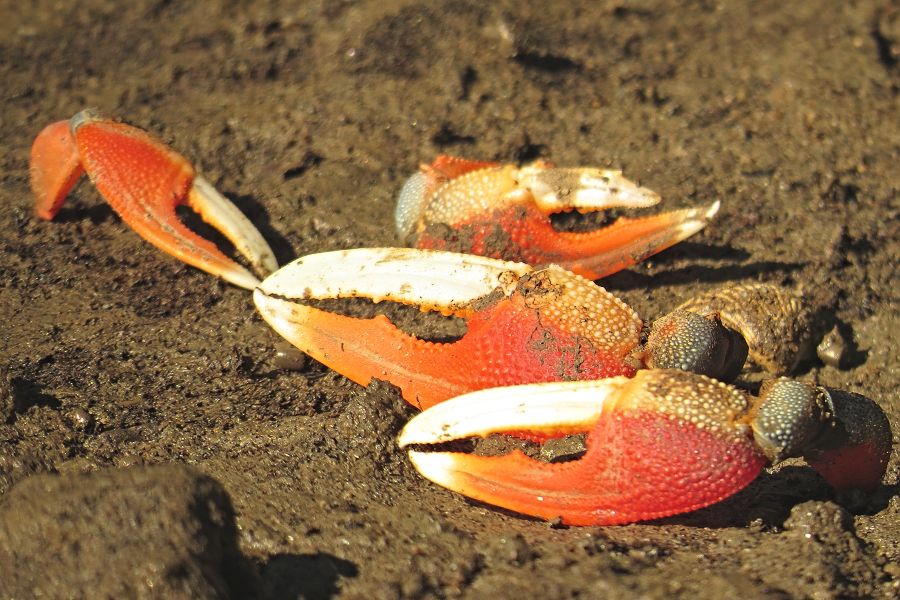
A lot of people have been looking at the “who eats fiddler crabs” post and I was starting to wonder if they had gone on the Paleo Diet.  When I wrote the first post, I was not sure which of our large birds had been dining on fiddler crabs but now I have collected more evidence.  Today on a small mud bank 10 m across, I found 4 detached nippers and bird footprints.  I would say a Beach Curlew (Esacus magnirostris) has been at work.
Uca dussumieri claws
The fiddler crab claws broken off by the bird - collected by me
There are more than a dozen large to very large birds in my area and some smaller ones with strong beaks, so working out who eats crabs is quite hard.  They very rarely eat crabs whilst you are watching and Beach Curlews are notoriously shy.  However I did see one giving something a really hard time one day and went to investigate.  I found the remains of a large sentinel crab.
Sentinel crabs probably put up a struggle and would be a bit bony to swallow, so the bird processes the crabs first and removes most of the hard bits.  It is more common to find the scene of the carnage than see it happening.

Esacus magnirostris, Beach Curlew eating a crab
Beach Curlew working on the shell of a sentinel crab
Sentinel crab remains
The actual crab shell from the Curlew's mouth
Scene of brutality against a crab, see the legs and shell.

Finally, I came across some Beach Curlew poo on a disused road that runs through the mangroves.  The curlews sleep there.  It is clear that crabs are a major dietary item.  When they eat soldier crabs it looks like the road runner in real life as they run the crabs down.  I don’t know how they catch sentinel and fiddler crabs as these crabs are fast and are always near a burrow.  Stealth is the more likely approach and I have seen Beach Curlews on the mud bank but they just stand there like they are waiting for the tide to go out.  They didn’t seem to be in attack mode.

Beach Curlew poo, mostly crab shell
On another web page someone said Whimbrels eat fiddler crabs.  Whilst this is possible and a Whimbrel was feeding near the mud bank, I would want to see more evidence before adding Whimbrels to the list.
Mouth of Richters Creek, Cairns - sort of place where birds catch fiddler and sentinel crabs
Uca dussumieri fiddler crab - the biggest of east Australia's fiddlers
Sentinel crabs in numbers on the sloppy mud.

Saturday, 28 June 2014

Legacy of Cyclone Yasi

Cyclone Yasi was a category 5 storm that crossed the Queensland coast just north of Cardwell in February 2011, which is more than 3 years before the photos in this post were taken.  Cyclones happen nearly every year in Queensland and most have little effect on mangroves, a few large, old mangroves fall but smaller trees survive and the ecology continues uninterrupted.  The difference with Cyclone Yasi is that it had a storm surge.  At Cardwell town which is only 1.5 km south of Meunga Creek, the storm surge was about 2-3 m above highest astronomical tide level and in places was accompanied by waves that were a few metres high.

The effect of the cyclone on the mangroves surrounding Cardwell was catastrophic.  A very high proportion of mangrove died along a 20 km stretch of low lying coastline was destroyed.  Many square kilometres of mangrove forest look like the photos below which were taken on 3 June 2014.

This was previously very tall and productive mangrove forest with a canopy at about 20 m
Rafts of timber which are held of the ground by stilt roots make walking challenging.
Wear a hard hat if you go in here and don't grab the trees as they are ready to fall.
Flakes of bark cover the ground - crabs eat leaves not bark and only a few sesarmid crabs are present.
Debris forms a timber floor in parts of the forest closer to the high tide line
Thirty days before the cyclone, a satellite image of the mouth of Meunga Creek was captured.  The site was also captured in late 2013, six months before the photos above were taken.  In the post-cyclone aerial photo, the living forests are mostly non-mangrove vegetation, mainly littoral rainforest or strand vegetation. The grey areas are central areas of mangroves swamp which were hit the hardest.  Patches of mangroves survived around the fringes.

Meunga Creek Mouth days before the cyclone - Jan 26 2011
Image taken 3 years later showing large grey dead areas.  Blue numbers show photo locations*.
*Photos relating to point 1 are in a previous post, those from point 2 are shown above and the regenerating mangroves are at point 3.

In Edmund Kennedy National Park which begins on the opposite side of Meunga Creek, there was a board walk for tourists through a similar mangrove swamp (no closed to the public).

Edmund Kennedy NP Mangrove Board Walk (now closed)
There are many varieties of mangrove swamp.  Spurred mangroves occur on higher ground, which is not flooded by every tide.  These mangroves are adapted to tolerating higher levels of salinity and do not  have the stilt roots or breathing roots that most other mangroves have.  Death in these forests was almost total.

dead Ceriops tagal
Destroyed spurred mangrove (Ceriops) swamp - spurs are another name for buttress roots
Paracleistostoma wardi
View of ground - every hole has a crab and the come to the surface and look at you when you walk
Recovery is slowly taking place.  In some areas, new stands of mangroves are developing.  After three years these dense stands have reached eye level.  I do not know whether these stands are developing from seedlings that were present before the cyclone or seedlings that established afterwards.  The stands are 20-30 m wide and beyond the stands, establishment of new mangroves is scattered to widely scattered.

Regenerating mangroves
Mass death of mangroves also occurred as a result of Cyclone Tracey and was documented but not investigated.  Searching Google did not reveal any clues as to why the mangroves died.  The canopies of the mangrove trees were intact.  Cyclone Larry shattered many trees but did not kill them.  Smaller mangrove that would have been relatively protected within the forest also died.  One clue is that strand vegetation which grows on the beach between the mangroves and the sea survived.  Mangroves on the leeward edge of the foredune also survived.  To me this implicates the soil as these mangroves were exposed to a least as much wind and wave action as the central areas of mangrove swamp.
Living mangroves on lee of foredune then dead mangroves further inland
Foredune vegetation is battered but recovering - many trees survived.
 I think it is time we found out what kills the mangroves.  We should also plan to replant mangroves should a cyclone every hit Cairns, as leaving the vast swamps that surround Cairns looking like a wasteland is not an option.

Tuesday, 24 June 2014

Something eats Fiddler Crabs

Just when I was beginning to believe that fiddler crabs were so good at avoiding predators that predators didn't bother with them, I find evidence of predation.  In a 30 m section of creek bank, I found 3 broken off fiddler crab claws and a partially eaten body.

fiddler crab claw


As I had observed that same creek bank at 9 am, I knew that the predation had occurred during the day as it was 3 pm when I observed the claws.  At night the forests are stalked by the Australian water rat (Hydromys chrysogaster), which is a voracious predator of crustaceans and is like a tiny otter rather than a rat.  Their footprints can often be seen in the mud and on the beach.  So what preys on crabs in the middle of the day.  It was not people – no fresh footprints and people did crabs up which makes a mess.  In fact their were no footprints which made me thing that the predator was a bird.  Birds can carry their victims away from the site of capture before processing their prey and swallowing it.  In this case the large claw was removed.

Without footprints the only way to check out suspects was to photograph birds and look for mud on their beaks.  In the patch of mangrove forest where the crabs were taken were kookaburras, black butcher birds and scrub fowl.  On the sand flats next to the mangroves were several more candidates including a beach stone-curlew and various herons.

Beach stone-curlew, white-faced heron and great heron
My bet is that it was the kookaburra that took the crabs.  Scrub fowl scratch for their prey and generally are not present in the mangrove except when they are moving between islands of beach scrub within the mangroves.  Butcher birds generally attack prey by gliding in with a dead straight trajectory so that their approach creates very little apparent movement in the eyes of the prey.  However crabs are fast and they run when other crabs run and the other crabs with different angles of view would seen the butcher bird move.  Herons seem to be interested in fish not crabs.  The beach stone curlew had mud on its beak, but this species is very shy and is a creature of open spaces.  I doubt that it would go into the mangrove to catch crabs.  That leaves the kookaburra.  Kookaburras often sit on a lawn waiting for something to move so I suppose they could do this in the mangroves.  The photo seems to show mud on the kookaburras beak, however they wipe their beaks on branches to clean them so there is only what looks like a film of dry mud on their upper beak.

Esacus magnirostris
Beach stone-curlew - Esacus magnirostris
Kookaburra
Kookaburra with mud on its beak a few metres from the crab remains

Sunday, 22 June 2014

Catching some Winter Sun

Fiddler crabs wave their nippers for various reasons. Some crabs seem to get stuck halfway through a wave and hold their nipper out for minutes on end. When I saw that the little feeding hand was also held out, it became clear that the crabs were sun baking. The crabs are also oriented to catch the most sun. Being Cairns on a warm day, it was not cold by any stretch of the imagination and I can only guess how warm these crabs were getting. Down in the boundary layer next to the ground, where the wind is almost non-existent, the crabs may get quite hot. Years ago, on a mangrove planting project, many of the mangrove droppers/seeds (Rhizophora hypcotyls) got so hot at the point the dropper entered the ground, it killed the droppers. There would be a ring of dead material at ground level, with the below ground part and the above ground part being fine. Based on that experience I would think that a temperature of forty degrees or more would be possible. These sorts of temperatures are often dangerous for invertebrates and it would be interesting to know why the crabs are warming them selves up. A thermal imager would have been handy to see how hot the crabs were getting – they are now only $350 or the price of a good compact camera.  
Uca vomeris
Uca vomeris in the sunbaking pose
Uca vomeris
All dried out

Wednesday, 18 June 2014

Who Eats Fiddler Crabs?

You would think that fiddler crab colonies would be a magnet for predators as the density of fiddler crabs is often really high.  However in all my years in the mangrove environment, I have rarely seen anything eating or attempting to eat fiddler crabs.  I suppose the lesson is that you often have to work hard to see predators in action.  It is also possible that fiddler crabs are not very good to eat.

Animals that are known/said to eat fiddler crabs include ibis, terns, possibly the giant mudskipper and the mangrove kingfisher.  At high tide, fish and rays will also eat any fiddler crab they can find. Mangrove kingfishers certainly eat crabs and recently I spotted one that appeared to be hunting fiddler crabs.  Being short of time, I could not sit and watch, however you can see several sets of fiddler crab eyes watching the kingfisher – look along the ridge line behind the kingfisher.  Mangrove kingfishers (Todiramphus chloris) are are much larger than other kingfishers and make a loud kak kak sound.

Todiramphus chloris
Mangrove kingfisher hunting crabs on the mudflats of Tingalpa Creek
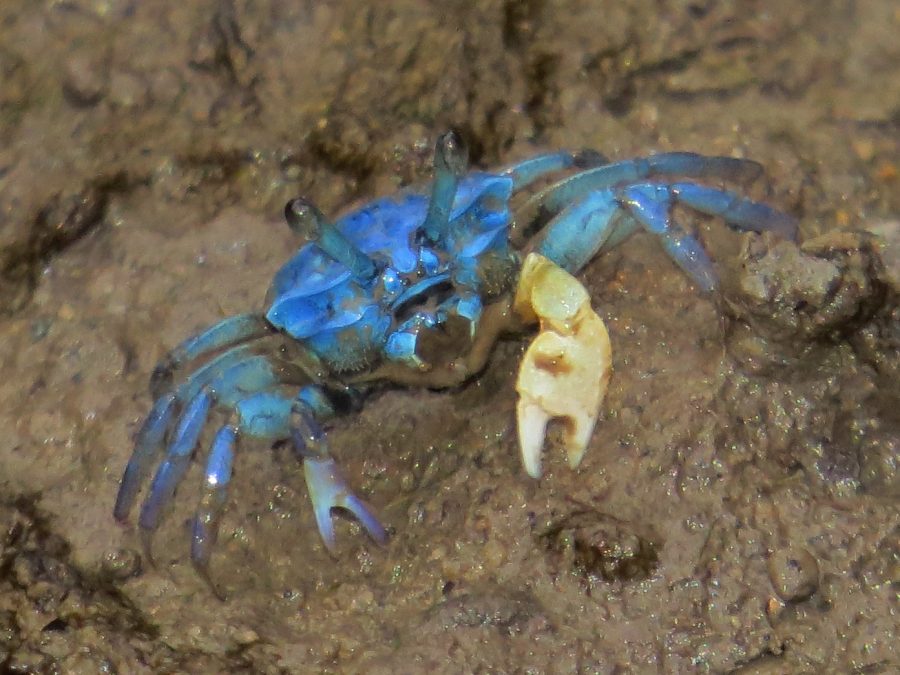
Below is the would be prey of the kingfisher, Uca longidigitata, a fiddler crab which is common on the mudflats of Moreton Bay, near Brisbane.  They are mostly not very colourful, however some are a turquoise with sky blue nippers.

Uca longidigitata

Uca longidigitata

Of all the birds, the Great -billed Heron (Ardea sumartrana) would seem to be the ultimate fiddler crab catcher.  It is a massive and powerful bird which stands around 1.15 m tall and is only slightly smaller than a Jabiru.  They usually hunt the mangrove waterways near river mouths.

Ardea sumartrana
Great-billed heron hunting along waters edge
I watched the individual above as it slowly walked along a river bank and through 50 m of particularly rich fiddler crab habitat.  The bird showed no interest in the crabs and was only hunting something in the water, probably mullet but possibly other fish and prawns.  This does not prove that great-billed herons don't eat fiddler crabs, only that this individual was not interested at the time of observation.  It would require observations of many great-billed heron individuals for tens of hours and in many places and seasons before a properly substantiated statement could be made.  That said, all of my observations of great-billed herons suggest they hunt fish not fiddler crabs.

Fiddler crabs behind a great-billed heron.
The one animal I have seen attacking a fiddler crab was a small juvenile mud crab.  It had was wresting with a mature male two-toned fiddler crab of the same size that had wandered past the mouth of its burrow.  Unfortunately I could not stop and see what happened.

Update June 2017
Since this post was prepared, I have been actively looking for Fiddler Crab predators.  Here are some other posts on the topic.


Sunday, 8 June 2014

Soldier crab's weapon

I was wondering why crabs are not present in all the places where I expect to find them.  Fiddler crabs live in the same context in the adjacent creek, why not here?  The only difference between the creeks is that flats below are sandy where as the other flats are have firm mud below the surface.  In some creek mouths, silt is deposited by floods, buried by sand and over a few seasons becomes a firm plasticine-like material.  The consolidated mud being firmer than the sand is probably harder for stingrays to forage in and for some species, this may determine whether survival is possible.  The sandy flat below is cratered with stingray feeding hollows and whilst soldier crabs here seem to be just hanging on, it seems fiddler crabs cannot.

Mictyris longicarpus habitat
Stingray hollows in soldier crab colony
We have two species of soldier crab in Queensland, the regular one that swarms at low tide (Mictyris longicarpus - below) and a subterranean one that I have never seen above the ground surface (M. livingstonei).  To check which species is present, it is sometimes necessary to dig one up.  It is a case of finding the vertical hole below the sand balls and placing a finger in the hole to find the crab at the bottom.  My finger met with unexpected pain on finding the crab so I had to investigate.  Soldier crab nippers are useless for nipping fingers, so what was the crab doing?  The crab has a spine near where the nipper joins the body and crab was pulling its nippers back hard, spearing my finger against the spine.  It was a raptorial motion like a prey mantis and it was a new trick on me.

Mictyris longicarpus spine
Spine soldier crab uses to fight
Mictyris longicarpus
Same soldier crab escaping

Naturally, that set me wondering what kind of predator might be deterred by such a weapon.  The usual cast of predators would not be deterred at all (kingfishers, ibis, toadfish and predatory crabs), however a newly identified predator may just be feel the spines, the moon snail - Conuba sordidum.  Click here to go to a video of some moon snail and soldier crab encounters.  The scientific paper on the topic is here.

Monday, 2 June 2014

Granddaddy of Fiddler Crabs

This is probably the largest fiddler crab I have seen in my life.  Like an old bull elephant, it was living alone some distance from a large colony of conspecifics.  I saw the crab from a boat and was able to take a photo without disturbing him.  I may go back and drop a ruler on the ground near his hole, take a photo when he comes out and measure him without hurting him.  My guess that his nipper is around 80 mm long when around 50 is closer to average.

Uca dussumieri

Life in the colony which was about 30 m away is intense and the big guy is probably looking to retire somewhere quiet.

Uca dussumieri, Uca vomeris
Uca dussumieri and U vomeris

Saturday, 31 May 2014

Two Species or One?

If you saw these crabs feeding side by side on the same mud bank would you think they are the same species?
Uca dussumieri

Uca dussumieri

I was certainly hoping they were different species as that would mean that I had found something new.  The first step is always to find a few examples of each.  A single strange individual could be a mutant, so it is important to find a few specimens to confirm that you are indeed observing a species.  Both types passed this test.  The crabs above are small juveniles, less than a centimetre across, so my next move was to try and find larger specimens.

Uca dussumieri

Uca dussumieri

Well the colour forms are still different, however the dark juveniles become dark blue as they grow and the sky blue juveniles develop patches of black.  Usually, I would look for features such as the fiddler crab's nose.  On the blue crab above, the nose is clearly visible but on the black crab, the dark colour and highlights from the camera flash obscure the nose.  Even with dozens of photos, slight differences in perspective, focus and reflection obsured the key features.  That will teach me not to examine live specimens in the field with a hand lens!  There were not many of these crabs, however, so I was reluctant to disturb them.

Uca dussumieri

Uca dussumieri

As the crabs get larger, it becomes much harder to tell which is which.  I am assuming that the top photo is from a dark juvenile.  The lower photo is a blue juvenile with carapace fading to black.  The mid-sided crabs are scarce so the sequence of colour changes is not clear.

Uca dussumieri

Uca dussumieri

The small adults of the dark form (now the red form) often have spots on their carapace which can be bright blue.  The blue form does not appear to get these spots.

Uca dussumieri

Uca dussumieri


Finally, we arrive at photos of fully grown crabs.  So far I have not found any clear morphological differences between the colour forms, so I have to conclude that they both colour forms belong to the same species, Uca dussumieri. This species is fairly uncommon, so it is difficult to find enough examples to fill in all the gaps and reveal any patterns or lack of patterns.  Each colony has only a dozen adult crabs and a score of juveniles.

Sometimes there are gradients between colour forms, particularly in fiddler crabs, however I find that I can identify crabs on the creek bank quite easily as one colour form or other across most of the size range. With the exception of the last pair of photos all the other photos are matched for location, date and size of crab. At this stage, I consider the colour forms to be real and not analogous to the gradients of colour forms which I have seen in other fiddler crab species.  Further investigation is needed.