Showing posts with label fish. Show all posts

Saturday, 6 May 2017

Most Beautiful Fish in the Mangroves

Sometimes floating mangrove leaves are really fish in disguise. Batfish take pretending to be mangrove leaves to an extreme. This post shows a Round Batfish (Platax orbicularis) that I found on the Cairns waterfront, in North Queensland, Australia.

A round batfish beside a floating mangrove leaf 
During April, the surface waters of harbour are alive the juvenile fish and mangrove-leaf-like batfish are suddenly present. They lie on their sides and almost drift passively with the current, making only slow motion movements to capture small food items.

The fish's face would often come out of the water when it was feeding

The fish would only be vertical when turning

Mangrove leaf mimick
So great was the fish's faith in its disguise, that I could almost poke a camera in its face.
In the few hundred metres of the Cairns waterfront, perhaps half a dozen are present. Naturally, I would prefer to be searching for fish in pristine mangrove wilderness, but my experience is that the marina is by far the best place to see fish that mimic mangrove material. Mimics seem to be more abundant in the outer estuary which has large tidal flows. Mangrove flotsom mimics are difficult to find in the long mangrove creeks where the same water moves back and forth within the creek instead of being flushed and replaced with new water on each tide. As the marina is at the mouth of the harbour and the floating concrete fingers trap floating objects, ideal conditions for observing mimics are present. Still, it is no coral reef and the pursuit of mimics needs a long attention span and time to waste. Many species of juvenile fish are only present for a few weeks of the year as they grow quickly and move to new habitats


Batfish begin life in the mangroves but live on coral reefs when they are mature. Where they come from before they become 'mangrove leaves' is not clear. I think that they first appear as the small dark fish that lurk in the shadows under the floating fingers of the marina. The dark young batfish swim vertically and are hard to photograph from above. Perhaps they mimic dark mangrove detritus, which sometimes swirls around in eddies below the surface. Fins turning orange is the main clue that these are juvenile batfish.


In Cairns Harbour, there are two species of batfish that pretend to be mangrove leaves, the Longfin Batfish (Platax tiera) and the Round Batfish (Platax orbicularis). There are also a several other fish that pretend to be bits of floating vegetation including sea grass, green leaves or pieces of bark. Perhaps, there are about 20 vegetation mimicking fish species in total.

Long-finned bat fish swimming around floating concrete fingers

Platax tiera juveniles


Below are some (suitably licensed) photos from the net that show how the batfish change after they leave the mangrove environment. Sometimes the adults return to the mangroves and can be seen swimming around the mangroves by snorkelers.

Longfin batfish in transition to adult form

Platax tiera
Mature longfin batfish


Wednesday, 17 August 2016

Sharks near Cairns Beaches

You rarely see sharks in inshore north Queensland waters, at least when you are out on the water or standing on shore.  In thirty years of spending time on the beach and paddling surf skis, I have only seen one shark, a large black tip reef shark.  Yet in this same area a few decades ago, the beach at Yorkeys Knob, there have been three shark attack fatalities, the most of any beach in Australia.  Tiger sharks are believed to be responsible however I don’t know why tiger sharks were implicated rather than bull sharks or even hammerheads. 

The impact of the fatalities at Yorkeys Knob and a number in Townsville which were all in the 1950’s was to move the Queensland Government to start the shark netting program.  Unfortunately shark nets are lethal to many innocent marine creatures.  At least 420 dugong were drowned in the Picnic Bay (Magnetic Island) shark net alone over a period of a few decades.

Fishermen regularly catch small sharks on Holloways beach, mainly newborn hammerheads.  Tiny little black tip reef sharks patrol the mangroves at high tide on Double Island off Palm Cove.  Larger sharks are also present and other people sometimes see them.  It is said that large sharks are attracted by trawlers even when the trawlers are anchored behind an island, possibly due to odours from nets that have not been cleaned.  I have also heard of large tiger sharks inside the Yorkeys Knob Marina swimming around the dredge whilst it was operating.  

About 10 years ago, friend of mine was spear fishing off Pretty Beach when a tiger shark took way too much interest in him.  He went down to the bottom and when the shark swam directly over him, he shot it through the lower jaw with a pneumatic spear gun.  This is desperate stuff as sharks are well known for surviving hits with powerheads and still continuing on a feeding frenzy.  Fortunately for him the spear went thought the shark’s brain and killed it instantly.  A week later the poor fellow died whilst spear fishing at the same place and was washed up on the beach.  He either had a heart attack or shallow water blackout.  When we helped to clean up his belongings, we found the sharks jaws and you could have put them over your head without scratching your ears.

In recent times most direct evidence I have seen of large sharks close to shore is large fish which have been bitten in half.
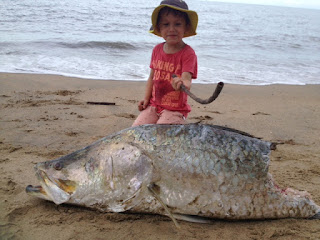
Lates calcifera
A very large Barramundi fatally wounded by a shark
The photo above was provided by Charlie who witnessed the barramundi leaping from the water in an effort to escape the shark.  The barrumundi was still alive when the people dragged it up on the beach.  It was humanely dispatched and then filleted! 

I once found similar fishy victim off Machans Beach. I was about 150 m from shore in a 11 foot tinny with a 4 hp outboard, when I saw a 10 cm fin sticking out of the water.  When I got close, I discovered that the fin was the anal fin of a very large Australian salmon that had been bitten in half.  It was too large to pick up with one hand even after many attempts and I had to leave it.  I don't think either fish was on the end of a fishing line when attacked, indeed I am not aware of anyone pulling in half a fish on a line either over all the years.

Very large Australian Salmon, probably 1 m long before it was bitten
Approximately 30 cm of fish was bitten off.  The fish was as thick as a mans thigh
I think it is a good idea to swim in the swimming enclosures that most of the Cairns Northern Beaches have.  At least do not swim in murky water or dark conditions when sharks cannot see properly as sharks will generally not attack people if they can see them properly.

Thursday, 14 April 2016

Hidden Fauna of Floating Mangrove Litter

For almost every type of floating mangrove debris, there is a marine creature that mimics it.  This post covers some of the mangrove litter mimics in the marina at Cairns in tropical Australia.  There are fish that mimic mangrove leaves, strands of seagrass and flakes of bark.  Surprisingly, not much seems to have been written about fish that mimic floating leaf litter. 


Floating mangrove litter can be surprisingly busy with many creatures being present around the same patch of litter.   The best places are where floating litter is spread out in thin lines or small patches.  Bigger patches have fewer creatures.  Perhaps they have been eaten by predators that pick over the larger patches.  Whilst mimics depend on looking like non-food objects, they would also benefit for being spread out thinly over a large area.

Leatherjacket mimicing tree bark (click to zoom in)
Pipefish that mimics floating seagrass leaves (the coarser Zostera leaves)
Mimicry is usually defined as a potential prey species closely resembling another animal species that is unpalatable or dangerous.  The term camouflage is used when an animal blends in with its environment.  However the fish shown in this post are closely resembling the appearance and behavior of discrete floating objects so I would considered the fish as mimics rather than camouflaged species. Many fish actually lie on their sides at the surface when threatened to better imitate floating litter.  This active imitation of the orientation and motion of floating objects goes beyond camouflage.

Unidentified green fish in the head down position beside a mangrove leaf
Same fish pretending to be a leaf when a herring approaches
The surface waters are also home to a number of specialised hunters that do not make use of mangrove litter.  All of these fish have excellent vision and can see predatory birds through the water surface and they relay mainly on speed rather than blending in.  Garfish and Archer fish are abundant. These large fish prey on small fish in the surface waters.

Sevenspot Archerfish checking out a black mangrove seed that looks like a baby squid
Longtoms patrol the open waters
Tiny fish seem to find refuge in a thin layer of water held by upside down leaves against the surface.

Unidentified fish hiding on top of a mangrove leaf
Small grunters are audacious hunters that attack tiny juvenile fish even when they are hiding on top of leaves.  Grunters can zip around at such speed that nothing could escape from them and very little could catch them.  Whereas most creatures of the floating litter move as little as possible, grunters are constantly moving, stopping briefly whilst they carefully observe their surrounds for potential prey.  The largescale grunter which were hunting in the mangrove litter often passed very close to mangrove litter mimics and either did not see them or avoided them on the basis that they were too big or too heavily armoured (scats and pipefish).

A grunter trying get to the garfish on the leaf
Same 50 mm long grunter hiding behind a mangrove flower
Tiny squid are abundant in the floating litter and larger squid often patrol just below.  Squid are predators and aggressively attack fish and even tiny squid would be a threat to juvenile fish.

Baby squid preparing to attack 
A bizarre creature that looked like a small section of tree branch covered by rough bark was flapping its way along like a hatchling sea turtle.  It was just an Estuarine Stonefish, but you don’t expect to see those feeding on the surface.  Scientific advice from a scorpion fish researcher is that stonefish do not have swim bladders so how it was managing to float was unclear.  It was however feeding.  In cases like this, a second observation of a different individual behaving in the same way is needed to establish that the behaviour could be normal behaviour for the species and not just an observation of an individual where something is wrong.    

Estuarine stonefish feeding on the surface
Mangrove herons also take a professional interest in the fauna of floating mangrove litter.  

Mangrove heron on floating walkway

Sunday, 6 March 2016

Glass Eels are Arriving in our Creeks

On 6 March 2016, it was a dark still night (~8 pm) and the tide had just peaked when I took a look in a tiny creek at the northern end of Palm Cove, Cairns, Queensland Australia.  The small fish that leap when a torch is shone on the water where not to be seen today and I had to look for creatures.  After a few minutes, it became apparent that every few seconds a tiny, clear living thread would zoom past. They were hard to catch and it took a while to get the first one.

Anguilla reinhardtii elver or glass eel

Anguilla reinhardtii
Glass eel or elvers of longfin eel (Anguilla reinhardtii) - click to enlarge
Most of them were following the thin film of freshwater that lay at the surface of the tidal creek. They were mostly moving through the thin film of the very margins of the creek, where the creek cut across the sandy beach.  In all the photos that follow, the gravel that is visible is actually some of the finest whitest sand in Cairns and it is just the small size of the eels that makes the sand look coarse.

Glass eel moving up the very boundary of the water - probably following a salinity gradient
Three glass eels are present in this photo
The glass eels rested momentarily in the mangrove detritus before striking out again.  It proved to be easier to capture the resting eels.  A highly venomous box jellyfish was also bumping its way along the bank.

Chironex fleckerii
Box jellyfish with 2 cm bell
It was so hard to photograph these small creatures in the surging water, I made a video.  The clarity is not great as fresh and saltwater are mixing near surface creating haze.


I captured a few glass eels to photograph and later placed them in an established freshwater fish tank with a few neon tetras.  The elvers seemed to handle an instant transition from saltwater to freshwater well and were alive in the morning.  Instant transitions kill most fish as their gills have to switch from excluding salt to absorbing it and kidneys from excreting salt to recovering it.  I guess that animals which are desperately seeking freshwater can handle sudden transitions.

Glass eels become large freshwater longfin eels when they grow up.  The creek at Palm Cove is very small and it is a wonder that glass eels were attracted to it.  There was a noticeable salinity gradient with relatively fresh water present at the very surface.  Upstream there is only 100 m of mangrove creek before the vegetation transitions into a paperbark/rainforest swamp forest.  These areas tend dry out in the dry season so how do the eels survive?  Back in April 2014, I was looking around in this area for interesting biodiversity when I found a mature eel half out of the water in the mangrove roots. I thought the eel was dead but when I got close, it took off.  Perhaps the eel was surviving by taking refuge in a thin film of freshwater floating above the seawater.

Mature longfin eel using mangrove roots to lift its body to/above the surface.
Place where I found the eel

Postscript
I took a few eels and let them go in my fish tank.  Two weeks later, most seem to be still alive.  After about 4 days they started to develop a dark skin, but their flesh is still clear.  During the day they hide under objects but at night they swim frenetically, perhaps 40 cm per second.  So they are not just trying to reach freshwater, they want to penetrate upstream as fast as possible.


Tuesday, 25 November 2014

Creatures that Live in Logs in Mangrove Swamps

There is a small fish that lives inside worm holes in mangrove trees.  I first saw this fish 25 years ago on a university field trip and I remember the fish being called a cobra fish but googling that term finds nothing and I cannot find its name.  Finding names for mangrove log creatures seems to be harder than normal as not much is published.  The first step is to get a good photo of the creature, not easy when you have to open up muddy logs to find them and then try to get clean enough to use a camera.  What I discovered is that the fish are certainly not alone.  The biodiversity in rotting mangrove logs is as high as the biodiversity of a rock pool.

The mangrove forest where most of the photos were taken - Redden Island
Shipworm holes can be large enough to put your finger in and many are calcified
A small shipworm showing the shells that bore into the wood
The key species in the rotting log ecosystem is the ship worm. These worms, which are actually bivalve molluscs grind away wood using their shells.  Logs soon end up riddled with hole that provide habitat for a wide range of creatures.  Logs also have other habitats. Common mangrove crabs make tunnels under logs, not that they need logs, just that they prefer to tunnel under logs than burrow out in the open.  Another range of creatures live in the space that opens up under the bark when the bark becomes lose.  As logs can be different sizes, in different states of decay and in a different position relative to tide heights, each logs is different and no log supports all species.  In all at least 20 species of macro-invertebrate depend on mangrove logs in north Queensland. 

The photos that follow show some of the creatures that I found under or within logs.  Every tenth log has something interesting.

Parioglossus interruptus
These dartfish were under the bark of a tree that was completely exposed and had been so for possibly hours or days.  I assume the fish were in this position before I lifted the bark
The fish which are about 20 mm long can also be found inside the trees in shipworm holes.  This fish came out of a hole when I chipped into a shipworm infested log.
Non-descript crabs are the most common inhabitant
Giant flatworms up to 60 mm long glide through cracks
A giant flatworm coming out of a shipworm hole.  See the eye spots.
My new species for yesterday - looks like a species of stone crab
This snapping shrimp was as long as my hand and was found under a log
A colony of shrimps was present in the tunneled log shown above
I have very little idea what these 80 mm long creatures are

Saturday, 14 June 2014

A Rare Hairtail

Sometimes I see mangrove creatures that are really interesting and never see them again.  Due to the toxic creek discussed in the previous post, I have rediscovered one of those creatures, Lepturacanthus savala which is hairtail or cutlass fish.  The fish died due to poor water quality which provided me with a chance for a look.  The fish I found is a juvenile, as adults are up to a metre long.

maybe Lepturacanthus savala
Hairtail or Cutlass Fish
According to fishbase, this fish is rarely caught and little is known of its biology.  Other fish with this shape often hunt in the dark and have special senses, so I assume that this is the case.
Lepturacanthus savala
Transparent dorsal fin

Lepturacanthus savala
This is the shiniest fish I have ever seen, note also the highly developed lateral line
This fish also has barbed fangs
I have only seen the fish once before.  A similar sized specimen was swimming at the surface not in the serpentine manner of an eel but like a plastic rod being bent into a curve then bent the opposite way. I suspect that this fish is like a deep sea predator that avoids flexing its body as it swims and attacks from below.  From above, it was very thin with a pair of very large eyes protruding from the sides.   It did not look agile at all and I thought to catch it by hand but it never came close enough to the bank to grab and it was sucked out to sea but the falling tide that raced out the creek mouth.


A Naturally Toxic Watercourse

Hydrogen sulfide (H2S) or rotten egg gas is often the smell of mangroves.  This poisonous gas is produced  by decomposing organic matter in the below the surface of the mangrove muds.  Normally the gas is only present in trace amounts and is wafted away in the wind or currents.   Very occasionally in prolonged still conditions, it builds up to levels that become toxic to life resulting in fish kills.  At very high concentrations, I suspect it kills patches of mangrove trees and it could be the main cause of the mass mangrove tree death caused by Cyclones.  Obviously understanding what hydrogen sulfide can do to ecosystems is important.  Yesterday, I found a strange example of an ecosystem stressed by this gas - the Blind Barron.  


In about 1942, the Barron River suddenly broke through the beach and created a new mouth about 1 km to the north.  The channel to the river old mouth filled with sediment and a flat beach ridge formed in what was the mouth.  A 1952 view of the Barron River mouth is presented below.  A pair of orange points have been placed on the image to mark two features that can be identified in both photos.


However mixed in with the river sand and mud that filled the old channel was a lot of mangrove leaf detritus, which creates hydrogen sulfide as it decomposes.  And this is where it gets strange.  The sand flats at the mouth of the Blind Barron (name of the old mouth) are higher than the bed of the Blind Barron so the water flows from the sand flats into the Blind Barron when the tide goes out – it looks like the watercourse is flowing backwards.   When the tide has gone out, the flow keeps going!  It is sustained by groundwater coming out of the beach ridge that has built up in the mouth the Blind Barron.  As the groundwater has been in a low oxygen environment that is rich in organic matter, it contains hydrogen sulfide.  When the tide comes in, it refills the beach ridge ensuring that on each low tide there will be plenty of groundwater.  The net result is a watercourse that fills with clean seawater at high tide and runs with contaminated water at low tide.  

Mangrove leaf detritus and shell grit
Freshly deposited mangrove detritus at mouth of Blind Barron which will generate H2S when buried.  The white material is shell grit.  Normally the presence of shell grit neutralises acid generated by H2S so I am assuming that the water is not acidic, only contaminated with H2S.
Pool at mouth of Blind Barron
This 50 m long pond is filled with contaminated seepage from the adjacent beach and sand flats
Pond water flows back into the Blind Barron at a high rate- shown here still flowing strongly many hours after high tide
Strange water colour - clearer than estuary water with a hint of colloidal cloudiness and blue tint.
View up the Blind Barron - it has high banks and a sandy bed
The extent of the toxic backflow is shown in this 2008 imagery.
The impact of the hydrogen sulfide is only on animals that live in the waters of the Blind Barron.  Life on the banks is not affected as the hydrogen sulfide is a low tide phenomenon.  The water was clear and inviting but smells like a volcanic spring.  It was noticeable but not powerful.  Toad fish were swimming around randomly in the water column and a mud crab was sitting in a hollow with its tail hanging down (It didn't want to be photographed).  One fish, a rarely seen hairtail or cutlass fish was lying on the bottom and died as I photographed it with my underwater camera.  

Lepturacanthus savala