Showing posts with label bird. Show all posts

Friday, 3 April 2015

Fiddler Crab Predators

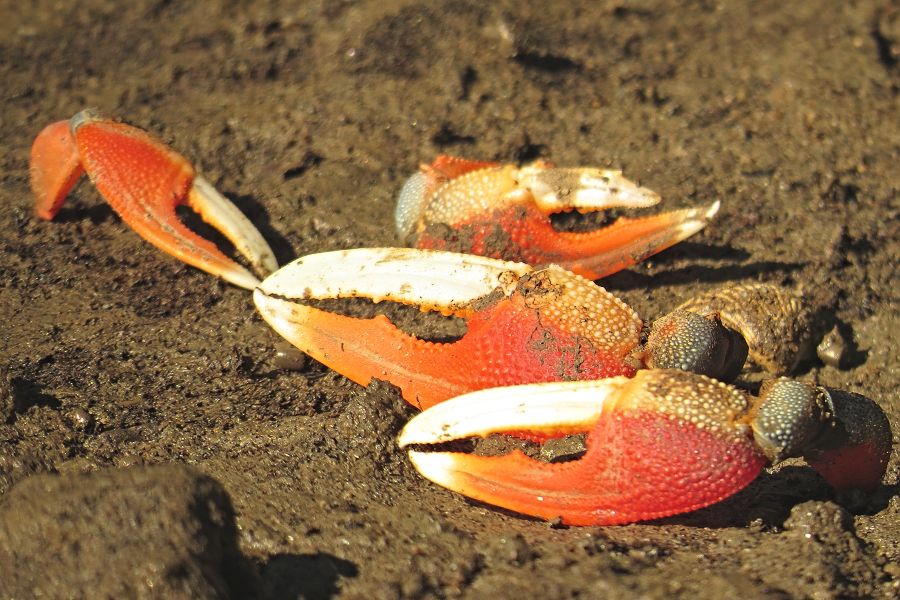
A lot of people have been looking at the “who eats fiddler crabs” post and I was starting to wonder if they had gone on the Paleo Diet.  When I wrote the first post, I was not sure which of our large birds had been dining on fiddler crabs but now I have collected more evidence.  Today on a small mud bank 10 m across, I found 4 detached nippers and bird footprints.  I would say a Beach Curlew (Esacus magnirostris) has been at work.
Uca dussumieri claws
The fiddler crab claws broken off by the bird - collected by me
There are more than a dozen large to very large birds in my area and some smaller ones with strong beaks, so working out who eats crabs is quite hard.  They very rarely eat crabs whilst you are watching and Beach Curlews are notoriously shy.  However I did see one giving something a really hard time one day and went to investigate.  I found the remains of a large sentinel crab.
Sentinel crabs probably put up a struggle and would be a bit bony to swallow, so the bird processes the crabs first and removes most of the hard bits.  It is more common to find the scene of the carnage than see it happening.

Esacus magnirostris, Beach Curlew eating a crab
Beach Curlew working on the shell of a sentinel crab
Sentinel crab remains
The actual crab shell from the Curlew's mouth
Scene of brutality against a crab, see the legs and shell.

Finally, I came across some Beach Curlew poo on a disused road that runs through the mangroves.  The curlews sleep there.  It is clear that crabs are a major dietary item.  When they eat soldier crabs it looks like the road runner in real life as they run the crabs down.  I don’t know how they catch sentinel and fiddler crabs as these crabs are fast and are always near a burrow.  Stealth is the more likely approach and I have seen Beach Curlews on the mud bank but they just stand there like they are waiting for the tide to go out.  They didn’t seem to be in attack mode.

Beach Curlew poo, mostly crab shell
On another web page someone said Whimbrels eat fiddler crabs.  Whilst this is possible and a Whimbrel was feeding near the mud bank, I would want to see more evidence before adding Whimbrels to the list.
Mouth of Richters Creek, Cairns - sort of place where birds catch fiddler and sentinel crabs
Uca dussumieri fiddler crab - the biggest of east Australia's fiddlers
Sentinel crabs in numbers on the sloppy mud.

Sunday, 28 December 2014

Fig parrots depart the nest

One young double-eyed fig parrot nearly did not make it.  The black butcherbird had him and was flying off but the butcherbird fumbled the chick and I was able to recover it.   It helped that the butcherbird was looking in the garden for chick, otherwise I would not have known where the chick was.  I do not know how the butcherbird caught the chick and I suspect that the chick was on its first venture out of the nest.
Cracticus quoyi
Black butcherbird thinking about how to catch caged birds
A day before, I photographed the chicks in the nest hollow.  When you move near the tree, they hide, but if you stand still for a few seconds, they can’t resist having a look.  It must be very hot in the still air of the hollow and in the late afternoon they are almost gasping for cool outside air.

Hiding fig parrot chicks
They can't resist taking a look for long
I imagine that a number of predators that stalk my yard could have eaten the chicks. Carpet snakes, lace monitors, tree snakes, kookaburras and of course black butcherbirds make up the main threats. Tree-climbing rats could also be an issue at night.  All these animals are present in the Cairns suburbs, particularly the older suburbs with quarter acre blocks that are not far from swamp or rainforest.  In fact, in mid-October I viewed a large chick in the nest and this chick may not have made it.  Birds grow fast and I do not think that a chick that was large in October would be the same bird as the chicks which I watched in December but then I do not know much about fig parrots.

The recovered and unhurt chick
I put the lucky chick back in the nest hollow.  He went in and was silent for half an hour.  The parents had seen the black butcherbird take the chick and then a human jump a fence and catch the chick so they were quite upset.  They refused to go near the nest hollow but instead flew some high reconnaissance circuits around the nest tree and made loud alarm calls.  The unaffected chick was calling for food loudly.  Suddenly I saw three parrots fly directly from the area of the nest to the dense canopy of a nearby weeping fig.  I suppose that both chicks simultaneously flew the nest.  The chick I rescued and that could not fly at ground level could drop from the tree to pick up speed then fly fast and level.  After six months of watching this nest hollow, suddenly it was empty.

Search this blog for fig parrot to see more.

Tuesday, 4 November 2014

Fig Parrot Chicks

Of highest priority to saving the endangered southern race of fig parrot is finding a next with chicks so that a captive breeding program can be established.  If you live south of Rockhampton and you see parrots like the ones in this post, take photos if you can and contact the Department of Environment and Heritage Protection (email address is in recovery plan). Look for cheerful little faces looking at you from the trees.
Cyclopsitta diophthalma
My favourite fig parrot - this little chick watches what I get up to (1/11/2014)
Cyclopsitta diophthalma
I stand about 5 m away and take photos with a superzoom camera.
According the species recovery plan published in 2005, “Coxen's fig-parrot [the endangered subspecies] is thought to nest in the same manner as the red-browed fig-parrot [the subspecies shown in this post]. Training in north Queensland will be undertaken to hone the skills necessary for locating the nest holes of Coxen’s fig-parrot. This exercise will enhance observers’ abilities in nest recognition, particularly with respect to the height, aspect, positioning and appearance of nest holes, the tree species favoured for nesting and the preferred breeding habitats. In addition, familiarity will be increased with the appearance, flight style, behaviour and calls of the similar red-browed fig-parrot. The training exercise in north Queensland should be conducted by members of the recovery team in October or November so that the experience gained can be passed on to others and applied”.  Most of that information can be found in this post and previous posts on this subject.

Cyclopsitta diophthalma
A chick in a large dead paperbark in the mangroves about 15 m above the ground (5/11/2014)
fig parrot nest hollow
When I first saw the hole in September, a parrot was in it but taking photos with a smart phone through binoculars was not successful. When I went to take a photo a few days later, green ants were trying to claim the hole.  However the chick above survived the green ants  
In late September, I started to hear the noise of chicks begging for food.  Sometimes, I would even glimpse a bit of baldy head but the parent would enter the nesting hole and push the chick back if I observed too closely.  Now the chick or chicks are older, they are getting interested in the outside world and spend a lot of time with their heads out of the burrow looking around.  This may be the best time to look for active nests as you can make some funny sounds and the chicks come up for a look.  They are much less timid than the adults.  Fig parrots never become tame and do not make good pets.  With their really small tails they do not make good aviary birds as they can’t turn quickly and tend hit the end of the aviary as full speed, hurting themselves.  I would be careful about handling a bird that is not tame and that can chew through wood, not to mention that handling an endangered species would get you in serious trouble.

Cyclopsitta diophthalma
Dad to my favourite fig parrot chick
Most of the time, the fig parrots that visit my yard target green figs.  They eat some figs including Ficus racemosa and ignore other figs such as Ficus superba.  Ficus variegata is also a favourite.  They eat the seeds of the fruit and spit out the flesh and normally feed on green fruit, which would are dreadful tucker from a human perspective as they are full of sap-flavoured, glue-like resin.  Ficus racemosa fruit are very good to eat when fully ripe and have a flavour like strawberries.  I a pretty sure that Ficus variegata never really ripens and is never good to eat.  When the figs are the best for me, the fig parrots have long lost interest and think the idea that they normally feed on ripe fruit needs to be discarded.  Fig parrots tend to pick a cluster of figs and quietly chew for hours.  Cluster figs may be far more important that species of fig which have fruit dispersed through the canopy.  Normally, I detect the parrots by hearing the plugs of fruit the spit out landing on the leaf litter beneath the tree. When a few birds are present, the tree literally drips bits of fig.  The birds also make small squeaks as contact calls and the parent generally calls to be chick before approaching the nest hole.

Cyclopsitta diophthalma
Green Ficus racemosa is the best.  There are two birds in the photo.
Ficus racemosa
This is the first and only time I have seen a fig parrot on ripe figs.
Previous posts:

Friday, 10 October 2014

Some Crab would be Nice


This should be easy
Come out, come out
So you want to be difficult
We'll just keep going around as long as it takes then!


Saturday, 4 October 2014

Swamp-oak Forest - Endangered but Hard to Love

Swamp-oak forest which occurs around Brisbane is an endangered vegetation type.  Despite being endangered, it was one of the most wildlife unfriendly vegetation types I had ever seen.  Even though swamp-oak forest straddles the highest high tide line, it has a fraction of the wildlife present in adjacent ecosystems.  Mangroves are full of life and the paperbark swamps and eucalypt forests have myriads of honeyeaters and even koalas.  Swamp-oak forest in contrast is so poor that a vast area of swamp-oak was planted around Brisbane Airport as it is so unattractive to birds, it would reduce bird strike at the airport.  Jet engines usually have to be rebuilt after they ingest birds, so bird strike can serious impact airline profitability.  Ansett Airlines threatened to quit Townsville due to this issue and I had to investigate the contribution that vegetation making in attracting birds to the airport.

Ibis eats McDonalds for breakfast in Brisbane CBD
In fact is was reported that the white ibis, which is the sworn enemy of the jet airplane, only became a nuisance after some were hand raised at a Gold Coast wildlife sanctuary and released into the wild.  These ibis were not afraid of people and became urban birds that raided rubbish tins and breed up into an unnatural population.  Unfortunately for Coolangatta Airport, the birds nested in a wetland not far away.  The bird strike issue was so dire, that people with long poles were hired to go into nearby forests and poke ibis nests to bits to force the birds to breed elsewhere.  Brisbane being not far from Coolangatta  for an ibis was reason enough for Brisbane Airport to plant swamp-oak on every patch of unused land to discourage the dreaded ibis and other better behaving wetland birds.  In my youth on the south side of Brisbane (~1980's), ibis were uncommon and were usually feeding on the banks of mangrove creeks and were never raiding rubbish.
An open forest of swamp-oak (Casuarina glauca)
Now that I have established that swamp-oak forest is a wildlife desert, I will ask you to reverse that position. It is not that the swamp-oak forest has improved, rather the surrounding land has become worse.  Bushland remnants in Brisbane are generally occupied by noisy miners, which are a vicious species of honeyeater that lives in large colonies.  Noisy miners harass small birds in to leaving or dying.  Magpies and butcherbirds help them in this nasty business. Brisbane bushland has also been overrun by invasive garden plants and barely resembles the native forest that once existed.  Now that the good environment has been overrun by baddies, the poor environments which are too poor for weeds and noisy miners have become important sanctuaries for the smaller birds.  Imagine what this means for the pre-development environmental assessment process.  Previously the poorer habitats would have been the automatic choice for development and arguments would be made for preserving the areas with the best remnant trees.  I will certainly be careful before making that sort of argument in the future.
A mistletoe bird eating mistletoe berries
This mistletoe is common in swamp-oak forest and has leaves that look like swamp-oak needles
Mistletoes with broad leaves are also found on swamp-oaks negating
the idea that mistletoe foliage resembles the foliage of its host tree
Mistletoes are a heavy burden for a tree
Besides being a place where you can still hear the voices of little birds, swamp-oak forest and saltwater couch grasslands are places of wide open space.  Only 8 km from the centre of the city (Storey Bridge) are the wetlands of Bulimba Creek, known as the Hemmant Recreation Reserve.   This area is about 1 km wide, 2 km long and between bridges, Bulimba Creek flows for 7.5 km through the wetlands.  Paradise it is not, but in a crowded city you take what you can get.  There is a canoe trail with racks and taps for washing canoes.  It is also possible to walk around but there are no formed trails.  If you need blue sky and open space, this could be your place.
Saltwater couch grassland bordered by mangroves and swamp-oak forest
Bulimba Creek
Saltwater couch grasslands are the home of the saltwater mozzie, so go prepared or go in winter when they are dormant.  And don't wear you good shoes. On very high tides, the saltwater couch grasslands are submerged.
Samphire plants grow in patches in the grass
Mangrove seedlings floating in a saline pool
Further Reading:

Monday, 29 September 2014

The Mangrove that Lives on Land

The stilt mangrove family, which has most of the world's mangroves, has even more members in the tropical rainforest.  So what do the relatives of the archetypal stilt mangrove look like?  In Australia, there is only one non-mangrove member of the family Rhizophoraceae, and it is called the forest mangrove.

Some saplings have distinctive plates of corky bark
A mature tree on in gallery forest on the high bank of the Wenlock River
Forest mangroves (Carallia brachiata) live in a wide variety of habitats.  In dry landscapes such as around Townsville and on lower Cape York Peninsula, forest mangroves live in gallery forests on the banks of streams and rivers.  In wet areas, they grow in springs and swamps and on hill sides in small patches of forest clustered around rocky outcrops.  Around Cairns, they are one of the most common plants in areas with rainforest regeneration.

Make me wet and I grow stilt roots
Perhaps the forest mangrove is like the ancestral mangrove.  Occasionally a forest mangrove will sprout stilt roots from its trunk although most of these will taper out before reaching the ground.    It has the ability to live in heavy mud and live in swamps that have prolonged flooding.  Forest mangrove foliage is very similar to stilt mangrove foliage.  The clearest difference is the small red fruit, which are most unlike the water dispersed 'droppers' of stilt mangroves.   A great variety of birds tuck into the fruit by day and bats eat them by night, making for a noisy fruiting season.  In aboriginal communities like Yarrabah, the kids also climb the trees and raid the fruit.
Fig bird eating a berry - see also the mangrove like leaves
Yellow oriole - which is actually green
A male koel, which is a very large and noisy cuckoo that lays eggs in willy-wagtail and pee wee nests.
A much smaller but similarly coloured shining starling.
Australia has five migratory fruit eaters (koels, shining starlings, Torres Strait pigeons, channel-billed cuckoos and rose-crowned fruit dove) which is more than any other continent and forest mangroves feed them all.

Monday, 22 September 2014

Where the Fig Parrots Nest

Having found some possible nesting holes of the endangered southern Queensland race of fig parrots in the mangroves, I thought that I would look around the mangroves near Cairns for fig parrot nests.  In one afternoon, I found about twenty nests so it seems that the urban-mangrove fringe is a major nesting habitat.

My favourite fig parrot has now been committed to her nesting hole for more that three months.  As she is in a very busy area, she is fairly tolerant to people and even tall vehicles brushing the foliage of the tree she lives in.  Unfortunately, she suddenly realised that I was intently watching the nest.  Being in an urban area, I am restricted as to where I can place the camera and had to go within about 4 m of the nest.  This was too much for the little bird, which jumped out of the hole and flew away.  Fortunately she later returned to the nest but after the fright, she became very cryptic and was hard to observe.  She has relaxed a bit since but I need to stay at least 6 m away.  Fig parrots living in the woods are not used to people and is better to give them at least 20 m of clearance.  If you have a flip out screen on you superzoom camera, you might use that to watch the birds to avoid the need to stare directly at the birds.

Cyclopsitta diophthalma macleayana
Don't trust the humans
It seems that my favourite fig parrot is not the only urban fig parrot.  There is a giant fig tree at Barlow Park in the centre of Cairns which has fig parrots in a trimmed up tree branch, a perfect demonstration that trimming trees in a certain way can create habitat for these little fellows.  The British use a technique call fracture pruning to leave some dead wood in tree crowns for their wildlife.  We could do something similar here, however fracturing the end of a dead branch would allow the centre to rot out quickly and fig parrots reject trees with hollow centres as far as I can tell.  Years ago, I strapped a heap of reject didgeridoos to the trees in my yard but nothing wanted to live in those.  Falling didgeridoos are dangerous so I connected them to the tree with fencing wire. A strand of wire would run along the top of the didgeridoo with some loops of wire wrapped around the instrument.   The other end of the wire was threaded through some poly hose and secured around a solid live branch.  This way, the didgerdoo could not become deadly.  A few super duper cable ties and some UV stable rope might also be a quick way of ensuring that dead wood can't fall until it has crumbled.

Fig parrot nest hollows in a pruned branch
- this tree was on the mangrove edge before the park was filled.
Close-up of the holes, not all holes become nests
- perhaps the wood needs to be not to hard and not too soft
My first mangrove edge fig parrot hollow was spotted on my drive to town.  It was in a dead pillar of a tree that is right beside the road verge.  In a short period of time, I found a few dozen fig parrot holes in tall stag trees.  The favourite trees are dead northern paperbark, Melaleuca leucadendra, which found at the very  edge of mangrove swamps.  In fact, they are so close to the mangroves that the small about of climate change induced sea level rise has killed many of them.  When you live on the high tide line, 3 mm per year of sea level rise over thirty years is a big deal.   I can remember all of these trees being within a strip of saltwater couch beside the mangroves.  Now the trees are in the mangroves and the wide grassy strip is gone as the mangroves have squeezed it out.  The dead melaleucas are very tall, almost 30 m tall and stand clear of the surrounding mangroves and beach vegetation so provide an exposed clear trunk.  Melaleuca wood is also much softer and less durable than eucalypt or acacia timber and I have found no nests in the later species.
Paperbarks that were born in grassland will die in the mangroves thanks to sea level rise
The massive branches of dead giants are perfect for fig parrots
There is one other factor that warrants a mention.  I have been trying to set a camera trap to catch a striped possum.  I suspect striped possums eat fig baby fig parrots if they can catch them.  Where there is striped possum sign, there are few fig parrots nests.  I suspect that fig parrots are doing best in places where pussy cats keep the striped possums out.  Fig parrot central is a peninsular like patch of habitat that juts into a Cairns suburb.  There is a strip of bush with tall paperbarks at the edges that is separated from the houses by a thin band of mangroves.  Most of the nest trees are within 50 m cat infested suburban land.  Conversely, I also occassionally find parrot nests that appear to have been enlarged which suggests that stripped possums may be using parrot nests for dens.  More research is needed.  Southern Queensland has a huge population of possums and perhaps some dead trees should be fitted with possum guards to give their endangered fig parrots a chance.

Many of the branches eventually snap at or near fig parrot nesting holes

Saturday, 30 August 2014

Saving the Fig Parrot

Brisbane has some beautiful coastal wetlands.  In large cities like Brisbane, the coastal wetlands are usually the last native ecosystems present that would be similar to how they were when the early settlers arrived.  The bush and rainforest have been transformed by weeds and have become an alien vegetation that is dominated by a handful of adaptable and aggressive species such as noisy minors that exclude other birds and animals.  Brisbane was a biodiversity hot spot but much has been lost.  Mangroves forests and salt pans which were once the poorest habitats for fauna have now become one of the richest as they are relatively immune to degradation.  Mangroves and the small islands of terrestrial forest they contain may even be the last habitat of some species.

Perhaps the rarest and most endangered bird in South East Queensland is Coxen’s Fig Parrot (Cyclopsitta diophthalma coxeni).  There are an estimated 100 individuals left but no one really knows as they are a cryptic species.  The small green parrots feed quietly on native rainforest figs and being the size and shape of fig leaves, they are very hard to see so targeted searches for this species usually fail to find any.  To save the species, the QLD and NSW State Governments want to start a captive breeding program, but nobody can find an occupied nest.  Stock for breeding programs is normally taken from wild nests.  I suppose that this would make my discovery of some possible old nesting hollows in a mangrove tree a significant find.

Cyclopsitta diophthalma coxeni
Possible old fig parrot nest holes in a mangrove beside the board walk at Nudgee Beach
A lizard in a stag beetle hole in the same tree.  The stag beetles may make pilot holes for the parrots.
Fig parrots make their own hollows.  Over about a month, they chew their way into a rotting branch.  Some hollows are about 60 cm deep which I discovered by finding fallen nest branches which split open when they landed.  If you find a fallen nest or any nest, be sure to report it to the national parks service.

Cyclopsitta diophthalma macleayana
Fig parrot in Cairns starting to tunnel - 17 July 2014.
fig parrot at nesting hole entrance
Stopping for a look around.
Cyclopsitta diophthalma macleayana
30 August, been sleeping in the hole for while now, but when there is a noise, the parrot comes to the entrance for a look (flash photo taken just after dark).
Cyclopsitta diophthalma macleayana
Female fig parrot begging for food from its mate.
Cyclopsitta diophthalma macleayana
Male fig parrot about to feed the female.
There is a species recovery plan for this species but it does not appear to address the nesting requirements for this species.  My knowledge of the subject comes from observing another subspecies of fig parrot, the red browed fig parrot (Cyclopsitta diophthalma macleayana) which is still common in Far North Queensland.  Fig parrots need rotting branches between 10 and 25 cm in diameter where the sapwood softens without the branch falling.   Live timber is too hard and in many cases would have unpleasant sap.  In nesting branches, often the sapwood rots away completely and the dead branch becomes an empty tube of bark when the parrot scrapes out the contents.  The favoured species are fig trees (F. drupacea) but I have seen nests in beach almonds (Terminalia arenicola).  I even have a nest near my house in a rainforest tree with one of the hardest scientific name I know of (Blepharocareya involucrigera).  Many of the nesting trees are in parks.  Twenty years ago, I would only see fig parrots flying in small groups high in the sky.  In only a few years, the fig parrots have moved into town.  I suspect many/most urban nests are lost to tree loppers who are called in to remove sick trees and dead branches.   If we can find places where trees can be allowed to old and decrepit, then every park fig in Brisbane City could one day be visited by this species.  Figs branches tend to rot until they become as light as foam before falling and if dead branches of suitable diameter were cut off a bit more than half a metre from living timber, the safety hazard from falling branches would be very small.  In fact many of the local nests around Cairns are in the stubs of branches that were trimmed by the city council.   Any branch with a gnawed hole or a gnawed test pit should be off-limits to tree trimmers.  The birds tend to chew out test pits until they find timber that just right.

Although I did find nest hollows in the mangroves, I do not believe that in general mangroves are suitable habitat.  Mangroves have high populations of rats which predate crabs and which would prey on parrot chicks as well.
Cyclopsitta diophthalma macleayana
Red browed fig parrot feeding on Ficus racemosa on an isolated tree on a sand ridge in the mangroves.
I suspect that another serious oversight of the recovery plan is that it does not address the food supply of the fig parrots.  Fig parrots eat green figs and not ripe figs. The northern fig parrots feed very heavily on Ficus racemosa and to a lesser extent on F. drupacea, both of which are native to Brisbane but which are rarely planted.  These figs are deciduous and drop very heavy crops of fruit a number of times a year so are not ideal park trees.   Planting these species around the margins of parks, particularly on the edges of the mangroves creeks and other places where people don’t typically venture might be a way of boosting food resources.  Fig parrots are highly mobile and isolated trees make up most of their food supply.  Another undocumented food is Melaleuca viridiflora flower buds.

Fig parrots feed for days to weeks on a single tree until fruiting stops and they return as soon as fruiting begins again, so isolated urban trees are likely to be extremely important to this species.  The species recovery plans should include the establishment a network of isolated trees which can fee the birds year round.  All the photos above were planted trees.  I planted them.

Tabbil-ban dhagun boardwalk at Boondall Wetlands
The 1.5 km long km board walk at Nudgee Beach is just across from Brisbane Airport - something to do before you catch a plane. 

Further Reading:
Coxens fig parrot Species Recovery Plan