Sunday, 4 September 2016

Hidden Life of Salt Pans

Marine salt pans look barren but there is life there when you look closely. The first surprise was that the salt pan was home to lots of wolf spiders.  They are the same colour as the ground and do not cast a shadow so it is hard to see them fleeing when our footsteps shake the ground.  Most of them are hiding in the cracks between the tessellating plates of parched earth.  Flies feed on the saline algal residues and I saw a spider leap several body lengths to land on a fly that was coming in to land.  However the spiders live in fear of the black wasps that hunt them both on the surface and through the cracked ground. 

A wolf spider (click to enlarge)
Whilst I was watching, a spider sensed that a wasp was looking a nearby flake of ground and abandoned its shelter to run for it across the open flats.  The wasp could smell the spider and was tracking it down.  On finding the spider’s trail the wasp would reach a frenetic pace with madly waving antennae.  The wasp was closing in on the spider and was within centimetres when it lost the trail and moved away.  Perhaps the trail rapidly becomes feint in the hot sun.  However the spider could not move when the wasp is in sight.  As the wasp moved off, I could see other spiders rising to the surface to survey the surrounds, initially mistaking the wasp for a fly before beating a rapid retreat.  I did not see the wasp find a victim and do not know where the paralysed but living victims end up, but they are probably carried by the wasp for at least 100 m to a sandy terrestrial area where they are buried in a tunnel to be slowly consumed by the growing wasp larva.

Wasp hunting wolf spiders
Wolf spider hiding in the crack (centre of photo)
Salt pans are flooded by tides at least every month and the parched ground collapses into soft mud without any cracks.  Where do the spiders go then?  Spiders can move over water quite easily and they might retreat to the patches of succulent vegetation.  The other possibility is that they hide in the ground.  On opening one of raised pimples that dot the saltpan, I found a spider inside together with a moulted skin.  The spider had been there for a while.  Perhaps it had even been trapped there, feeding on the tiny creatures that abundantly burrow through the mud.  This would be the spider equivalent of the frogs in stone phenomenon.

Small raised bumps cover much of the salt pan
On gently opening a bump to see what was inside, I found a spider and its old skin
The open salt pan seems to be habitat for spiders and insects rather than marine creatures like crabs.  Air breathing arthropods can better tolerate the harsh swings from wet to dry and from nearly freshwater after rain to hyper-saline when tides retreat and salt is concentrated by evaporation.  Many of the species present are not confined to salt pans and the spiders and wasps in particular are common in nearby vegetated sand dunes.

Flies (centre) and other insects feed on the mud and algae
The mud surface covered with tiny burrows and mounds of excavated material
Where salt pans are different is that they have a wet surface or shallow pools of water that are exposed to the full sun and grow a mat of algae.  This algal mat can support a vast population of insects. There are myriads of tiny critters that live in tubes or burrow in the mud and which feed on the algae.  Unfortunately, mosquito larvae are one of the insects that can thrive in these pools, so an understanding of the ecology of this zone is very important.  Ruts from motor vehicles driven over salt pans increase mosquito breeding potential exponentially as undisturbed salt pans usually drain and dry too quickly for mosquitoes to breed.

A wild pig foot print allows a colony of crabs to develop
Larger fauna can be found around the margins on the salt pan.  Mud crab burrows were quite common and most were surrounded by a small patch of mangroves.  It appears that the mangroves depend on the mud crab somehow.  I suspect that the crab hole helps to moderate the salinity by providing better drainage for a metre or so around the mouth of the burrow.  The mangroves persist for a while after the crab disappears but life for a mangrove in a salt pan is uncertain and without the crab hole, the trees probably perish after a period. 

mud crab burrow in north Queensland
Mud crab hole in a salt pan
Hiding under the mangroves around the edges of the salt pan are huge numbers of mud creepers and these a possibly the main prey of mud crabs.  Mud crabs also graze on vegetation and I wonder if they feed on the algal mat as well as molluscs.

Mud creepers (mainly Telescopium telescopium) sheltering under a small mangrove 
A Telescopium shell, possibly after being predated by a mud crab
The empty salt pan competes for space with great patches of succulent vegetation.  In the dry season this vegetation is like a psychedelic shag pile carpet with green, pink and purple mottles.   This part of the ecosystem supports large numbers of crabs and small air breathing molluscs.  The succulents appear to prefer the better drained areas.

A carpet of samphire vegetation on a salt pan near Port Douglas
In close-up, samphire vegetation looks like an alien forest
I suspect that the areas I have written about in this post are the areas that are shallow, brackish water ecosystems in the wet season with succulents occupying slightly raised areas which have better drainage.  Both are wetland ecosystems that are watered by tides and during the rainy season, by a film of freshwater due to water being shed from the flat landscape no faster than the water is replenished from the sky and by seepage from nearby land.

The salt pan lies between patches of samphire vegetation
The ecotone between salt pan and samphire has a parchment like algal crust

Wednesday, 17 August 2016

Sharks near Cairns Beaches

You rarely see sharks in inshore north Queensland waters, at least when you are out on the water or standing on shore.  In thirty years of spending time on the beach and paddling surf skis, I have only seen one shark, a large black tip reef shark.  Yet in this same area a few decades ago, the beach at Yorkeys Knob, there have been three shark attack fatalities, the most of any beach in Australia.  Tiger sharks are believed to be responsible however I don’t know why tiger sharks were implicated rather than bull sharks or even hammerheads. 

The impact of the fatalities at Yorkeys Knob and a number in Townsville which were all in the 1950’s was to move the Queensland Government to start the shark netting program.  Unfortunately shark nets are lethal to many innocent marine creatures.  At least 420 dugong were drowned in the Picnic Bay (Magnetic Island) shark net alone over a period of a few decades.

Fishermen regularly catch small sharks on Holloways beach, mainly newborn hammerheads.  Tiny little black tip reef sharks patrol the mangroves at high tide on Double Island off Palm Cove.  Larger sharks are also present and other people sometimes see them.  It is said that large sharks are attracted by trawlers even when the trawlers are anchored behind an island, possibly due to odours from nets that have not been cleaned.  I have also heard of large tiger sharks inside the Yorkeys Knob Marina swimming around the dredge whilst it was operating.  

About 10 years ago, friend of mine was spear fishing off Pretty Beach when a tiger shark took way too much interest in him.  He went down to the bottom and when the shark swam directly over him, he shot it through the lower jaw with a pneumatic spear gun.  This is desperate stuff as sharks are well known for surviving hits with powerheads and still continuing on a feeding frenzy.  Fortunately for him the spear went thought the shark’s brain and killed it instantly.  A week later the poor fellow died whilst spear fishing at the same place and was washed up on the beach.  He either had a heart attack or shallow water blackout.  When we helped to clean up his belongings, we found the sharks jaws and you could have put them over your head without scratching your ears.

In recent times most direct evidence I have seen of large sharks close to shore is large fish which have been bitten in half.

Lates calcifera
A very large Barramundi fatally wounded by a shark
The photo above was provided by Charlie who witnessed the barramundi leaping from the water in an effort to escape the shark.  The barrumundi was still alive when the people dragged it up on the beach.  It was humanely dispatched and then filleted! 

I once found similar fishy victim off Machans Beach. I was about 150 m from shore in a 11 foot tinny with a 4 hp outboard, when I saw a 10 cm fin sticking out of the water.  When I got close, I discovered that the fin was the anal fin of a very large Australian salmon that had been bitten in half.  It was too large to pick up with one hand even after many attempts and I had to leave it.  I don't think either fish was on the end of a fishing line when attacked, indeed I am not aware of anyone pulling in half a fish on a line either over all the years.

Very large Australian Salmon, probably 1 m long before it was bitten
Approximately 30 cm of fish was bitten off.  The fish was as thick as a mans thigh
I think it is a good idea to swim in the swimming enclosures that most of the Cairns Northern Beaches have.  At least do not swim in murky water or dark conditions when sharks cannot see properly as sharks will generally not attack people if they can see them properly.

Monday, 8 August 2016

Oyster Reefs of Far North Queensland

In ecology an oyster reef is the classic example of an open ecosystem.  In open ecosystems nutrients pass through the ecosystem whereas in a closed ecosystem, nutrients are mostly recycled.  There are no truly closed ecosystems that we know of; however some of rainforests would come close.  Larger coral reefs also have a high degree of nutrient recycling so are functionally close to being a closed ecosystem.  Oyster reefs are open ecosystem because the oysters feed on plankton imported by water flowing over the reef and the oysters export frass and sometimes oyster eggs/sperm into the flow.  Nutrients come and go and only negligible amounts are recycled.  Given their conceptual importance, I was surprised that so little attention has been given to oyster reefs.
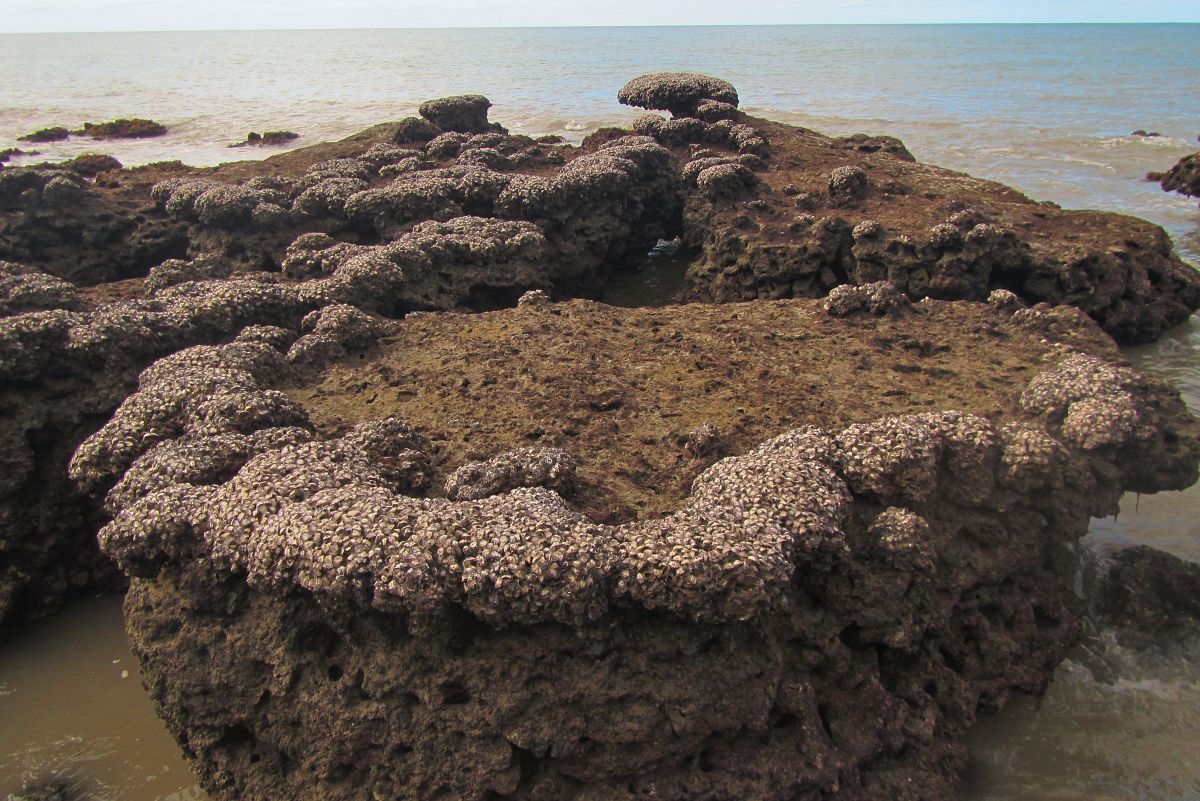
Mushroom-shaped oyster reefs on bed rock outcrops at White Cliffs, Captain Cook Highway
I noticed that oyster reefs were a distinct ecosystem on tropical Queensland shores about one year ago.  Wikipedia defines an oyster reef as a dense aggregation of oysters that forms a large colonial community.  Oyster reefs have their own ecology and can exist independently of mangroves, coral reefs and other tropical ecosystems.   As oyster reefs are small, ranging from less than a metre across to patchy reefs a few tens of metres across at the most, they are easy to overlook.

Band of oysters on landslide boulders at East Trinity boat ramp (click to enlarge)
Given that oyster reefs are nature’s equivalent to patches broken glass, it also took me a while to want to investigate them.  Oyster shells can easily cut into human skin.  Small pieces of shell often remain embedded in puncture wounds and cause serious infections.  Wading barefoot across a mud flat studded with oyster covered rocks is a testing experience as even the mud between the colonies is full of sharp buried shells.  A common way to have this dreadful experience is to pull up to a beautiful beach with a wide shallow reef flat that forces you to get out of the boat and walk ashore.  Some beaches have oyster covered stones, known as oyster beds, on the reef flat and these are the ones to be careful of.

Stony sand flats such as this one at Giangurra often have oyster beds 
Juvenile oysters cover many of the stones and these have cylindrical spines
One of the worst places I have ever been was a saddle oyster reef at the mouth of Saltwater Creek near Cairns Airport.  Saddle oysters (Isognomon ephippium) are about 12 cm across with thin almost circular shells that when closely stacked look like a bed of axe heads.  Silvery dead shells littered the ground around the reef my first impression of them was of miniature compressed humanoid skulls.  The circular part of shell is offset to one side like the braincase of a skull in cross section and the hinge has a series of deep grooves that resemble tooth sockets.  The saddle oyster reefs stretched right across the bed of a creek that was only millimetres deep a low tide.  I was trapped between a series of these barriers and could not paddle my surf ski out or walk out as the soft mud was as deep as my legs were long and stretched for hundreds of metres.  It was the most vulnerable to crocodile attack I have ever been.  Having no easy exit, I decided to investigate the reef properly so that I would never have to come back, before committing to a two hour slog across the mud flats that involved sitting on the tip of the ski and kicking with both feet to move just 30 cm. 

Saddle oysters reefs consist of tightly packed vertical shells
The surrounding area is covered with their dead shells
Isognomon ephippium
The shells look like weird skulls
A milky oyster reef near Pretty Beach on the Captain Cook Highway lacks the danger but was also a bit depressing.  It is located on the crest of an uplifted coral reef that has very little living coral or other life. The oysters are only present in narrow bands around the margins of the coral platforms.  Oysters normally form a horizontal band on rocky shores that is close to high tide level.  As the entire top of the old coral reef is at oyster level, yet only some places have colonies of contiguous oysters, some other environmental factors must also be important.  I wonder if oyster colonies form much like snowflakes form with edges of the colony that are subject to the most current recruiting the most spat.  Curiously, there is little fouling of living milky oyster reefs by other organisms such as algae and barnacles.
Uplifted coral reef near Pretty Beach, Captain Cook Highway
Looking along the uplifted fringing reef
Not all reefs are ugly and some oyster reefs are pretty enough to be photogenic, particularly the shelves of oysters that form on rocky headlands or on huge boulders that landslides have delivered into the sea.  Unsupported shelves of oysters can extend out for over a metre.  Rough seas probably break off shelves that have grown too wide.  The oysters in the shelves are arranged like a malformed honeycomb into tall roughly shaped polygonal columns.  Most of the column is solid shell and is formed from layer upon layer of shell secreted underneath the living oyster.  Some of the solid columns are more than 10 cm long.  Unfortunately the columns are weakly banded and it is hard to count seasonal ‘growth rings’. 

Massive shelf of oysters near Thala Beach Lodge (White Cliffs)
Same shelf from other direction showing gap where part of reef has broken away
Small oyster reefs in lee of Taylor Point, Cairns
The ultimate oyster reefs in my opinion are the small unattached oyster reefs that lie on sand and mud flats.  These reefs are self-regenerating in that the only place new oysters can settle is on old oysters.  Self-sustaining unattached oyster colonies are not common with only few seen for each kilometre of coastline and they always occur on the landward margins of wide sand or mud flats.  I have also heard that aborigines once returned old shells to the sea so that new oysters could grow and it would be amazing if this was the origin of the unattached oyster reefs that I have observed.

Unattached oyster reef at mouth of Johnstone River, these oysters tend to get eaten by people.
Unattached oyster reefs with milky oysters develop on dead saddle oyster shells
An oyster colony in a midden at Weipa, shellfish were the major food source for local aborigines
All of the oyster reefs prefer relatively semi-sheltered waters or on exposed coasts, positions where waves are broken before impact.  They also prefer large rocks that stand in deeper water and which are probably less prone to sand blasting during rough weather.  It is thought that the lower limit of oyster growth is related to predation.  On floating walkways in marinas, oysters only grow near the water surface and are heavily predated.  Oysters often do much better on the piles within the marina oysters as piles are exposed when the tide recedes. 

Oyster reefs do not like places with high energy wave impacts
When trying to work out why oyster reefs form where they do, it occurred to me that oyster reefs might also be a real world example of DaisyWorld, which is the mother of all ecological theories.  Oyster reefs are mostly bright white yet they live on black rocks.  During summer, the rocks can get super-hot and suffering limpets stand up on their feet like mushrooms to get some air under their shells.  However oysters breathe water and must remain tightly closed and like daisies, they cannot move so heat must be a critical issue.  In Daisy World, white daisies cool the world by reflecting sunlight so could oyster reefs work this way too.  The next step is to look for scientific papers as surely this topic has been researched.  If not, doing some data collection on temperature differences between bare stone and oyster colony would not be too hard.

Oysters seem to do much better in colonies than they do as scattered individuals
One of the few rocks with scattered oysters, showing lots of dead oysters
In other countries and other parts of Australia, the habitat and ecosystem services provided by oyster reefs are highly regarded.  In north Queensland, the rich variety of habitats means that the contribution of oyster reefs to local species diversity is quite low.  However, there are organisations springing up to restore and recreate oyster reefs that have been destroyed over the years, including the Shellfish Reef Restoration Network.  In early Australia many oyster reefs destroyed for various reasons.  Some were mined and the oysters burnt to create lime for concrete.  In many places there has been a major loss of oyster reefs.  

NSW Oyster Fisheries 1883, Source: State Library of Victoria
Oyster reefs provide a complex three dimensional space where creatures could live, however the position of oysters at the top of the tidal range probably limits the number of species that could make use of that potential habitat in north Queensland.  I did not observe much biota making use of the habitat provided by oyster reefs I have examined.  Crabs including stone crabs and half crabs sometimes shelter under unattached oyster reef on tidal flats and algal turf sometimes occurs on old dead shells. 

Well developed oyster reef often has fissures and holes
This older reef has algae turf on the matrix of old dead shell
Large shelfs can collapse, creating oyster boulders that provide habitat for other creatures 
Oyster shells collected from beach that probably come from broken down reefs
1.  Due to crowding the oyster lives in an ice cream cone shaped space inside the column of shell
2.  Column seen from bottom, showing robust outer wall and layers of shell sealing
of the unwanted space below the living oyster
3.  Most columns have a stripe on one side and I assume this is the attachment surface
4.  This column (oyster shell) is 9 cm long, but columns can get a fair bit longer
Oyster drills are the most common visible natural predator of oysters.  In NSW oyster beds that once extended from the high tide line to the bottom of the coastal harbours but sub-tidal colonies were wiped out by introduced mudworms.  Humans are probably the main predator of the remaining oyster beds and reefs in the upper intertidal zone.  Indigenous people and to a lesser extent other people scour most of the coastline near Cairns looking for oysters which they mostly consume on the spot.  In accessible sections of coast, oyster populations are often depressed by over harvesting.  However given the notoriously poor diet of indigenous people, fresh oysters are probably a very important dietary supplement. 

An Oyster Drill - Morula marginalba


Tuesday, 26 July 2016

What Beach Vegetation was like 30 Years Ago

Back in the mid-1980’s when I first visited the beaches of the Barron River Delta near Cairns in tropical Australia, they had coastal vegetation consisting of open woodland with scattered large old trees, small thickets of saplings and wide open grassy areas.  As the beach was rapidly retreating due to sand mining in the Barron River, the face of the beach was completely covered in fallen woodland trees.  Today beach almond and casuarina trees dominate the foredune and these were planted by revegetation groups in the mid-1990’s.  What was once open and sunny is now heavily shaded forest with an understorey of mainly Singapore daisy.  Coconut palms, which were entirely absent along the uninhabited stretches of beach,  have been planted all over the place by people who think that all beaches need them.

Holloways Beach as it is in 2016 - a vista of Casuarinas and coconut palms
Much of the strand forest is beach almond, which create shady forests
Usually a blanket of Singapore Daisy covers the forest floor
There are some vestiges of old style coastline near Cardwell and along the coastline near Yarrabah, to the east of Cairns and these provide the photos in this post.  Small vestiges also occur on Taylor Point and inaccessible areas of the Cook Highway coastline on the way to Port Douglas.

Holloways and Machans had scattered trees in tall grass (this is Edmund Kennedy NP)
Tall paperbarks occurred in the swales between dunes and made up many of the fallen trees when the beach retreated
Dry rainforest trees occurred in pockets on the edges of the dunes.
Savanna was present on the sandy flats bordering mangroves (Redden Island)
I suspect that I arrived at a particular time when indigenous burning had been suppressed and the vegetation was in the process of change.  Without fire or attempts to graze the land, the vegetation rapidly thickened.  Vegetation thickening is when too many tree saplings become established and they fill up all the space between the larger trees forming what looks a bit like dry rainforest. 

Before thickening the forest had large trees with an understorey of shrubs and blady grass
After thickening, spindly saplings form most of the forest and the understorey plants are virtually eliminated
Since 1994, non-eucalypt bushland trees have replaced the previously grassy understorey and the tall trees have since died
To someone who has seen the bush before thickening, today’s thickened bushland is painful to look at.  When I first saw the north Queensland woodlands they were full of well-formed trees and shrubs that were very healthy and which had attractive dense foliage.  I now suspect this was the first generation of trees growing up in the reduced fire regime and was transitional to the thickened forest that we see today.  Younger people probably think that the forest remnants they see are representative of what once existed, however this is not the case.

South of Yarrabah had seaside eucalypt woodlands in 2016
The tip of Taylor Point has a tall and thriving sward of giant spear grass
For wildlife, I think that the beach vegetation of eucalypt/paperbark woodland with pockets of dry rainforest was more productive for animals other than black cockatoos which eat beach almonds.  In thickened vegetation the bulk of the saplings struggle to survive and barely fruit or flower.  In contrast the understorey shrubs in the grassy woodlands have more space and can thrive and produce much more food for animals.  Finches and wrens love the grass.  On the beach with the blady grass, every metre of beach had wildlife footprints, including water rat, bandicoots, wallabies, goannas, and even crocodile.  It is amazing how much wildlife these area can support in there natural state.

Wallaby and joey footprints on the beach