Monday, 4 February 2019

Southernmost Mangroves in the World (almost)


In Australia, mangroves reach as far south as Corner Inlet at the very bottom of Victoria and are almost the southernmost mangroves in the world. The mangroves described in this post, were only 40 km further north at Western Port Bay which is an internationally important wetland. 

I wanted to know what mangroves are like at the extreme end of their distribution and how they compare to tropical mangroves? Which mangrove fauna and flora species are missing and which remain at the geographical limits of existence? 

I found the mangrove ecosystem in Western Port Bay to be as simple as a mangrove ecosystem can get. However, the saltmarsh behind the mangroves is sensational. There is a riot of colour and visual texture.

The saltmarsh stretches to the horizon
Jellybeans (Disphyma crassifolium)
Selligera
Triglochin
Samolus repens
The saltmarsh in early summer is a vibrant carpet of green as it is really a seasonal freshwater wetland that is watered by groundwater. In winter the rainfall is slightly more than summer and the evaporation rate is low, so groundwater rises to the surface. At least twenty species of succulents and grasses contest every patch of space. In the saltmarsh, there is even an understorey of miniature species growing below the canopy of small shrubs and herbs. Between the inner saltmarsh and the mangroves is a wide band of tall succulent bushes belonging to the saltbush family.


Metre high thicket of Tecticornia arbuscula
Close up of succulent stems of Tecticornia arbuscula
Tiny flowering daisies grow between triglochin plants
Other tiny daisies are almost all flowerhead
The best place to see mangroves and saltmarsh in Victoria is at Hastings on the Mornington Peninsula. There is a saltmarsh and mangrove boardwalk which is a few kilometres long and there is also a carefully maintained coastal grassland which also has tracks. Having boardwalks is fortunate as the mangroves are shrubby and as thick as a hedge.

Native coastal grassland
Warringine Park Boardwalk
As this part of the world has cool wet winters, there is a season excess of groundwater that flows through the sandy soil and emerges within the saltmarsh. In summer, the groundwater levels fall and the regular 3 m tides can flood the area with seawater. Hence the plants that are present all need to be tolerant of salinity. There were no salt pans, however, which makes this ecosystem markedly different from saltmarshes or samphire flats in Queensland.

With 3 metre tides, the creeks are quite deep yet narrow

In shallow lagoons, black swans would feed on aquatic plants. Wrens and honeyeaters would flitter around in the succulents. Birdlife reaches its peak on the mudflats and seagrass bed beyond the mangroves and thousands of ducks feed in the shallows.

Black swans feeding on aquatic vegetation (Lepilaena sp.)
White ibis
White-eared honeyeater
Crabs species are very few. There appears to be only 4 species of crab, of which only one species is abundant. This main species is the semiphore crab and it occupies all of the niches from sand flats beyond the seaward fringe to the upper intertidal. It only needs regular seawater inundation to thrive. It is a surface feeder like fiddler crabs. Fiddler crabs are conspicuous by the absence and the Queensland mud crab is also. The other mangrove crabs are opportunistic feeders and would feed on algae, dead insects and possibly mangrove propagules. In the adjacent forest, I found fox poo full of crab shells, so the crabs need to be fast at escaping predators including both native ones like ibis and introduced like foxes.

Adult semephore crab  (Heloecius cordiformis)
Red-fingered marsh crab (Parasesarma erythrodactylum)
Fox poo with crab shells in it
Common fish within the mangroves seem to be limited to yellow-eye mullet and smooth toad fish. Tiny gobies are present in the creeks but as herons are abundant, they zoom of rapidly when they see you. Molluscs were also limited to two species of pea-sized snail that feed on the mud surface.
Smooth toadfish
Salinator snails
Ophicardelus ornatus snails
In the seaward mangroves, the lower trunks have barnacles and support a species of gastropod, which feeds on the algal turf growing at the base of the trunk. The mangroves look healthy although some places had sooty mold infestations on the leaves and scale insects. That is a possible sign of environmental stress.
At the seaward fringe, the Avicennia marina mangroves reach about 3-5 m
Barnacles on a seaward mangrove
Sooty mold on mangrove leaves, white dots are scale insects
Beyond the mangroves are yabby flats and sea grass beds. Wading birds were not present when I was there in November. Wading birds actually take time to move down the Queensland coast so appear in Victoria much later than they do in Queensland. Instead, ducks, herons, cormorants and sea gulls and black swans were present in numbers.

Seagrass beds are exposed at low tide
Ducks grazing in seagrass meadows
The sand flats are soft and you quickly find yourself knee deep in sediment. Dead bivalve shells are abundant within the ground and over the surface. The seagrass beds trap a layer of warm water at low tide and I wonder if this helps the biota escape from the cold for time. Staying upright whilst moving through the soft ground of the seagrass beds was difficult and in the few metres I could survey, I did not find any fauna.
The marine yabbies are so abundant, they made the ground soft
Stingrays bring old shells to the surface when the make hollows
Underwater photos of the seagrass bed
Deeper in Western Port Bay, there must be substantial populations of fish as near the boat ramps, were dozens of large fish skeletons. Giant seagulls pick away at them.

Juvenile Pacific Gull - these things are seriously over-engineered


Friday, 2 November 2018

Volcanic Reefs of Mission Beach


At Mission Beach are some unique rocky reefs of volcanic origin. Local volcanoes produced a very fluid lava that spread across the landscape in long streams. One of these streams created Clump Point, a finger of land which juts almost a kilometre into the sea. On aerial photos, other lava flows are easily identified including a few that are partially or fully submerged. Old lava flows are also hidden two metres below the tourist trampled white sand of Mission Beach.

Pelicans resting on a lava flow, a few hundred metres from shore
This post looks at a pillow lava reef which was five kilometres out to sea. This rocky reef probably breaks the surface far more than it is submerged. There is no beach and no terrestrial vegetation, only a hectare sized patch of black rocks. It is very hot and not very interesting unless you are a biologist. Even then, you want to study this place properly the first time so that you do not have to come back. Surrounding the reef is a sandy seabed and the margins of the reef have a hedge of sargassum. Coral is not to be seen.

This lava reef is five kilometres from shore

The edge of the old lava flow has sargassum and is surrounded by a sandy bottom
When you stand and stare long enough, you realise that this reef has a rich diversity of algal turf grazers. Fish, crabs and snapping shrimp battle for territories of turf. Blennies would attack and drive off much larger crabs. Crabs with heavy nippers would become frustrated with trying to clip the turf and would push their faces into the turf to chew it off directly. Even snapping shrimps would graze the turf using their larger nippers like shears with long, thin, lightly built arms darting over the surface picking up bits and pieces.

This snapping shrimp was cropping algal turf with the big nipper and picking at it with a skinny green nipper

A common hairy crab - Pilumnus vespertilio


A swimming crab grazing with its mouth

Another type of hairy crab grazing with its nippers
Large, heavily built crabs consume molluscs, both oysters and many gastropods that would normally assume the grazing role. Oysters were limited to exposed edges where water flow would be better and predator access more limited. Only a few neritas and cowries were on the basalt reef.

Ozius truncatus
A black finger crab is able to crush strong sea shells
On a nearby reef trochus shells were present. The nearby reef was a different geology, possibly a contact zone rock which was melted by the lava flow, then re-solidified. Corals also performed much better on this substrate.
Trochus shell in pocket in rocky reef

The underside of the same shell

A rocky reef that is probably contact zone rock, rather than basalt.

Volcanic features such as dykes and cliffs of solidified ash are present on nearby islands and on the mainland. At the bottom of one of these cliffs was a rock shelf which was only just inundated at high tide. On this shelf was a very shallow pool and a few rocks, fallen from the cliff. It was a particularly nasty place, intensely hot and saline. Yet when I looked, most of the stones were surrounded by a wide black halo. I also had the feeling that something was hiding behind one of the stones. I walked around the stone about five times and didn’t see anything but could hear frantic splashing. The only way to find out was to lift and remove the rock. A few crabs ran off but there were several large gobies stranded in a film of water too shallow for them to swim in. Apparently this species chooses to live in this habitat, a tiny area of the very worst aquatic habitat I could find. I love finding exotic creatures in places were nothing should be able to survive.

Dusky Frill Gobies in very shallow water on a rock platform 

The rock I lifted to see the fish

Wider view of platform of compressed volcanic ash


Wednesday, 26 September 2018

Mossy Mangroves in the Daintree


Moss does not usually grow on the ground in mangrove swamps. In fact there seems to be only one species of marine moss. Whilst, I lack the expertise to officially identify this moss, I have found mangrove forests in the Daintree, where the forest floor is carpeted with moss.

Mangrove moss, possibly Taxithelium merrillii

Moss-like algae is common in the mangroves but the sporangia show that this is really moss.
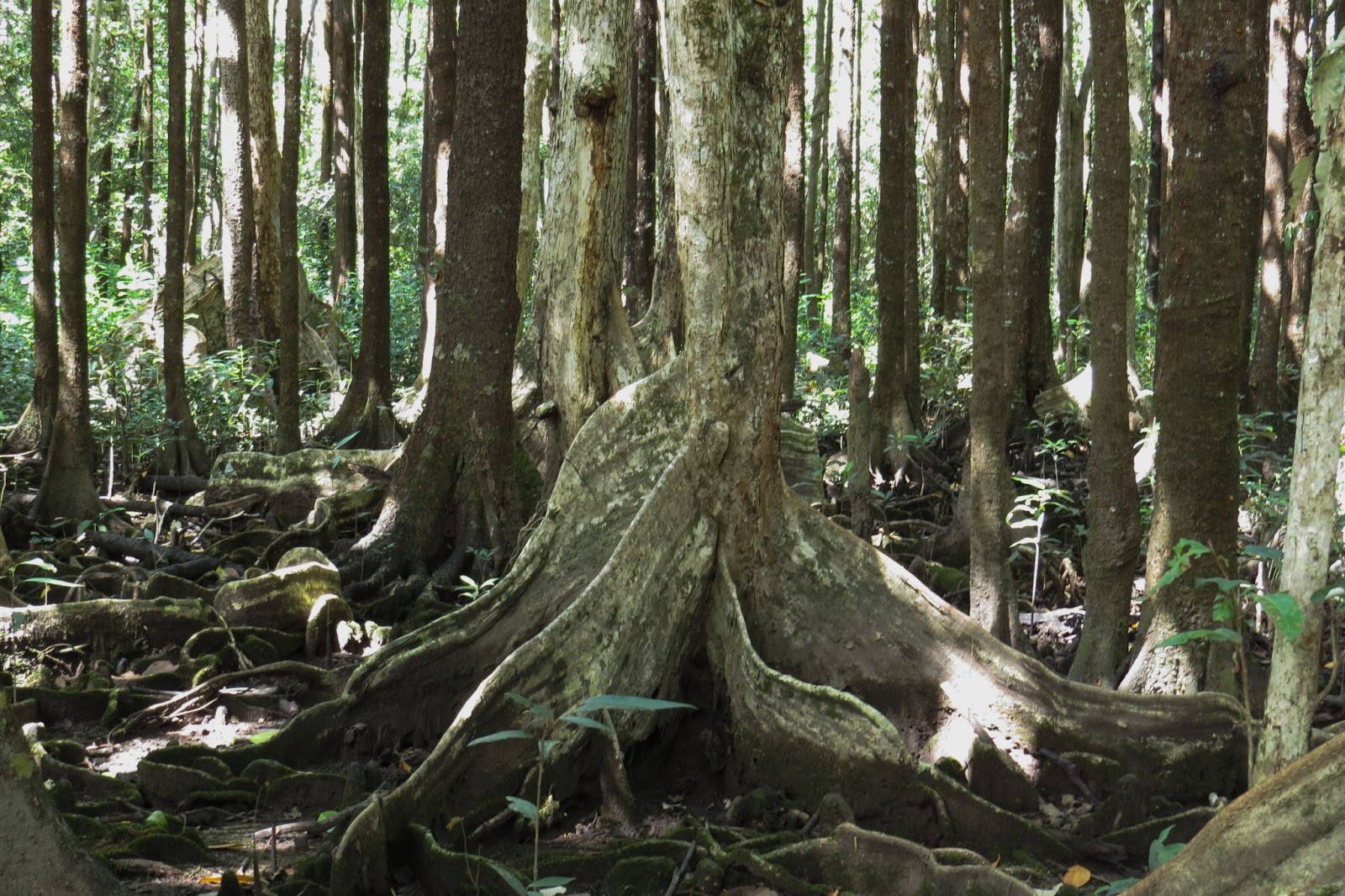
The mossy ground is in the back swamps, where the ground level is high and conditions are almost terrestrial. Only the tree species reveal that these areas are of mangrove character and not rainforest. The ground is more soil than mud and crabs are scarce. Buttress roots from Looking glass mangroves meander across the ground for several metres around each tree. Stands of these trees create a ground-level maze for the forest's smaller creatures. Scrub fowl scratch and poke around among the roots. Above in the canopy are giant basket ferns. It is like an alien ecosystem.

Scrub-fowl are as large as roosters and buttress roots are far larger

Some of the buttresses are as high as a man and twist across the forest floor for 10 m.

In peak condition, Looking glass mangroves are one of the tallest species.
This unique mossy habitat is only 50 m wide and perhaps a kilometre long. It is probably only found near the Daintree River although it may also be present in the coastal regions of our wetter northern neighbours.
This band of forest is the only mangrove forest where really large buttresses were the dominant root structure.

Almost a kilometre away, this intriguing stand continued.

Where the stand transitions into mangroves, a thick understorey of mangrove seedlings was present.
Further up the Daintree River is a freshwater mangrove swamp. Even though the water in this area would be fresh enough to drink for most of the year, it is still tidal. During droughts the freshwater dwindles and sometimes these areas are exposed to full seawater. These events are tolerated by the freshwater forests and their fauna. I suspect that the mud is always close to saturation and does not absorb much saltwater. Often the small amount of freshwater that persists also forms a protective film on the surface of the river. One consequence of not having seawater inundation is that the animals that feed on what the tide leaves behind are absent and creek banks are often smooth and almost devoid of crab holes. Only crabs that feed on fallen leaves are present and in very fresh areas, even these are usually absent. The fish are more exciting and I have previously written about the fish that choose to live in these habitats.

Freshwater tidal area with red Sonneratia mangroves and River Cherry trees.

River cherries, Barringtonia mangroves and sedges grow in a tidal forest.

On the river, the breathing roots can be as tall as a man.

Where the surrounding landscape has not been converted to agriculture, these brackish and tidal freshwater reaches are as extensive as the seaward edge of the mangroves. In most areas, only traces of this habitat remain.

Saturday, 10 March 2018

Fish spawning in the big wet

The day after the 2018 March deluge stopped, the local stormwater drain was full of fish. Not just any fish but strikingly colourful fish. These fish had come to spawn. They are all native fish that are usually brown, but on this day they were dressed up to impress. Two species were putting on a show, snakehead gudgeons and empire gudgeons. Snakehead gudgeons, not to be confused with Asian snakeheads or fishzilla, are a native Australian fish of mangrove estuaries.

Giurus margaritacea
The females were fat with eggs and males where brightly coloured (click to zoom)
Giurus margaritacea
A pale snakehead with bright ventral fins
The snakeheads gudgeons slowly circled in the main pool with males showing their colour to the females. There were two males and each time one made a move toward the girls, the other would approach and swim beside the first male to make sure that the girls knew he was there too. I did not see any fighting and the boys sometimes followed the girls and vice-versa. It was speed dating in slow motion and eventually the girls decided who was best.

Giurus margaritacea, courting
Two males trying to entice a female to their corner of the pond
Around the edges of the pool were bright red male empire gudgeons. At about 8 cm long, they were so full of confidence, that they were even approaching the 25 cm long snakehead gudgeons, which annoyingly had large patches of red. By the afternoon the empire gudgeons were gone, probably having expended themselves, they had ceased displaying. Their colours would have back to mostly brown although the keep their red head.

Hypseleotris compressa, male in breeding colours
Male empire gudgeon displaying on wall of drain
Surprisingly, the drain was almost empty before the deluge. Only a few rainbow fish (Melanotaenia splendida) had colonised since the wet reestablished a persistent pool at the outlet of the drain. In dry years, the drain can be dry for most of the year. During the wettest years, it can flow for most of the year and can support a diverse freshwater fish community of a dozen species. Being above normal tidal limits, the water within the drain is completely fresh, unless an extreme tide pushes in. Paperbarks and beach hibiscus line the drain and the beach hibiscus have grown long trailing roots into the flowing water, which now form a thick mat that the migrating fish have to negotiate.

Hibiscus tiliaceus creates deep root mats in flowing freshwater
Giurus margaritacea  close-up of head
Female snakehead gudgeon resting in the root mat
The drain is somewhat special. It is near the mouth of a river, so when the juveniles of freshwater fish are flushed out by floods, they often attempt to swim up the drain. Originally, before development, there was supposed to have been a drainage line in much the same position. Small creeks and drainage lines would once have been common but now have been replaced by farm drains and urban drains. There are not many small intact waterways which flow during the wet but dry out and prevent common freshwater fish such as guppies, tilapia and even native jungle perch from dominating the ecosystem. Perhaps this explains the desire for the gudgeons to breed in this waterway. 

Pool where water leaves concrete drain
stilt mangroves
25 metres below where the drain emerges,the freshwater flow fans out in a mangrove swamp
In the late afternoon, I decided to put my underwater compact camera on a pole and push it below the surface to see if I could get some close up photos. As I can’t clearly see what the camera is shooting, I use video, then create stills from the video. It was almost unbelievable, what the camera recorded. The fish were in the process of spawning when videoed.


The next day, I went back to try and get some new shots and the fish were largely gone. Only two or three snakehead gudgeon were present and they were much more wary of people and darted for cover. Males of both species were loitering and hoping for late females, but had lost most of their colour and enthusiasm. They only consolation was that I was able to photograph the very tiny eggs (white specs) that had been glued on dead wood the day before. The video clip shows these very eggs being deposited.  Firstly the female glues them to something with the pink appendage and then the male fertilises them (not visible in this clip) using a similar pink appendage.


Giurus margaritacea
Tiny white eggs deposited on a stick
Whilst I have called the fish snakehead gudgeons, I am not totally sure as they were identified using photos from the net. Usually, spangled gudgeons (Ophiocara porocephala) are the main local species and are of similar size and shape. So few photos of the fish in their breeding colours are on the net, that positive identification is difficult. Usually, it is best to review several sources, particularly authoritative sources before labeling species.

Spangled gudgeon usually hunt around this area.